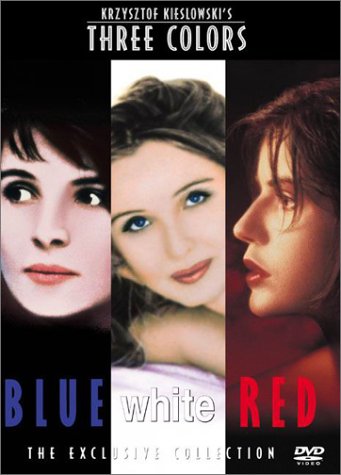
PLAYING FAVORITES is an exercise in self-mutilation. That explains why I would have to wring my hands if I were to pick my Top 10 from my DVD collection. Forgive me if I had to flick my eyes into adding five more titles to appease myself. So here are the 15 stuffs, each of which I have watched at least three times so far (and still raring to get bowled over again):
http://www.hotfreelayouts.com/movies.phpNEXT IN LINE:
1)
Partice Leconte's Man On The Train2) Tommy Lee Jones' The Three Burials of Melquiades Estrada3) Zhang Yimou's Hero4) Rob Marshall's Chicago5) Sam Mendes' American Beauty 6) Francois Ozon's 8 Women7) Peter Jackson's Lord of The Rings Trilogy8) Steven Spielberg's Schindler's List9) Mike Nichols's Angels In America 10) Walter Salles' Central Station11) Rober Pulcini's American Splendor12) Jon Wright's Pride and Prejudice 13) Spike Jonze's Adaptation 14) Mike Leigh's Vera Drake 15) Billy Wilder's Sunset Boulevard
MAKE BELIEVE is more real to me, sometimes. A hopeless cinephile, I also hope I won't be rolling my eyeballs if and when I'd throw caution to the silver screen and find myself so effing self-indulgent. Here's a sneak peek: Raising your brow about your own celluloid prospect? Kick yourself and click on http://www.quizgalaxy.com
 KNOW THYSELF, a poet exhorted. Because looking at my reflection might be tantamount to molesting the mirror, I deemed it wiser to subject myself to an online objective analysis to see what sort of animal my personality might peek-a-boo at me. So one tense afternoon when the deadlines felt like a cabal of monkeys nestling on my head, I allowed myself to kill time with the Enneagram Test at http://web.tickle.com. What the ancient science of personality says about you, or so Tickle.com took me by the tail.
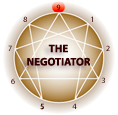
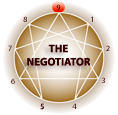
"Uncovering the complex mysteries of personality isn't just a modern fascination. For centuries, mystics, Jesuit priests, psychologists, and social scientists have studied the ancient personality typology known as the Enneagram. The Enneagram identifies people as one of nine distinct personality groups — groups that were developed to describe the whole human experience," states Tickle. "Understanding where you fit into the Enneagram's typology can provide the key to gaining new insight into your core motivations and attitudes. It can also unlock the secrets to better relationships with others. Take the Enneagram Test now to find out more about what makes you tick and fuels your opportunities for love and success." After breezing through 46 questions, here goes the verdict: Myke, you're a Type 9: The Negotiator 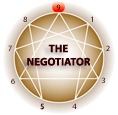 "Friends, family, and colleagues likely appreciate this unpretentious way about you and admire the good-natured approach you can take to relationships and life in general. They're also apt to know that when they come to you with a problem, you can be counted on to be reassuring and patient. As a Negotiator, you're likely to be seen as a good moderator and communicator who emphasizes finding equitable, amicable resolutions to problems.Being a member of this type puts you in good company. Whoopi Goldberg, a champion of progressive social causes, and the late Jim Henson, an inspirational dreamer and world-renowned puppeteer, are also Type 9s.This means that compared to the eight other Enneagram types, you have a strong sense of inner peace and stability that drives you to resolve conflicts, or potential conflicts, in your path. You're someone who can probably be committed to healing yourself and others while balancing yourself with a happiness that comes from life's simple pleasures."Won't it be nifty if someone from the United Nations get to read this?
Letters in All Writing Systems Traced Back to Nature, according to Yahoo News dated today (26th of April, 2006) THE SHAPES OF LETTERS in all languages are derived from common forms in nature, according to a new hypothesis.
The idea, in some ways seemingly obvious and innately human, arose however from a study of how robots see the world.
Robots employ object recognition technology to navigate a room by recognizing contours. A corner is seen as a "Y," for example, and a wall is recognized by the L-shape it makes where it meets the floor.
"It struck me that these junctions are typically named with letters, such as 'L,' 'T,' 'Y,' 'K,' and 'X,' and that it may not be a coincidence that the shapes of these letters look like the things they really are in nature," said Mark Changizi, a theoretical neurobiologist at the California Institute of Technology.
 Changizi and his colleagues think letters and symbols in Chinese, Latin, Persian, and all 97 of the other writing systems that have been used through the ages have shapes that humans are good at seeing.
"Evolution has shaped our visual system to be good at seeing the structures we commonly encounter in nature, and culture has apparently selected our writing systems and visual signs to have these same shapes," Changizi said.
The idea is put forth in The American Naturalist magazine.
Changizi notes that a basic shape such as "L" can be easily bent to form a "V." He found 36 shapes that require just two or three contours, and he then correlated these shapes to common scenes in nature and in ancient architecture.
"So the figures we use in symbolic systems and writing systems seem to be selected because they are easy to see rather than easy to write," he concludes. "They're for the eye."
Even graphic art that is not necessarily alphabet-based conforms to the idea. 
"Company logos, for example, are meant to be recognized, and we found that logos have a high correlation," Changizi said. "Shorthand systems, which are meant to give a note-taker speed at the expense of a commonly recognizable system of symbols, do not."
 (A lecture-testimony to the fellows of the 2nd Lamiraw Creative Writing Workshop in Calbayog City, Samar, 22-24 September 2005)
ON THE WAY to this workshop, there was no turning back to the facts revealed in the headlines of Cebu's newspapers: A policewoman stationed at the Women's Desk (where the complaints of abused women are heard) was murdered by her own husband. A 12-year-old girl was also killed after her own father and her uncle allegedly took turns raping her. Masked men, in vigilante fashion, remained on the loose after leaving corpses of suspected criminals. Meanwhile, the governor of Cebu had joined the Cardinal's call for an end to the bloodshed between two warring fraternities. On the political front, the city mayor and a congressman from an adjacent city were locked in a squabble on jurisdiction over a reclaimed strip of real property. Elsewhere, of course, the primetime news had been cranking up cliches ad nauseam about the doggone state of our nation: leadership crisis, the circus in Congress, a ping-pong of allegations about corruption, protests galore, and restlessness about an impending oil price increase. 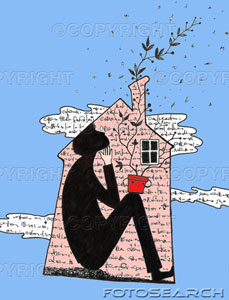
These news, come to think of it, are a rehash of a reality reported in newspapers, say, twenty years ago. The personalities may have changed, but the circumstances remain. Talk about bad news, and there's really nothing new about this notion of badness under the sun: rotten politics, reckless policies, regrettable interpretation on the concept of public service.
Obviously, some lessons we were supposed to know in kindergarten have been outgrown or, worse, forgotten. From these horrible happenings, certainly, we have not yet learned. Or how come we seem cursed to repeat all these things too bad and too boring as they remain true in our times. Strange, indeed, in the face of this so-called enlightened times in the summit of human achievement, in this era of information technology. So strange that the recurrence of this phenomenon patent in our headlines and primetime scoops might as well be the contents of the X-Files any Martian gone astray on earth would contemplate as an interesting subject for an essay on the human condition.
That we are apparently trapped in this vicious cycle worthy of any struggling writer's indignation, that we are running in circles, indicates a failure of imagination. That we appear stuck and trapped in a labyrinth means we have not yet found the way out of the dark. That, indeed, the idea of transcendence and breaking through barriers remain fancy notions devoutly to be wished despite our inventions, our books, our songs.
Failure of imagination is also apparent in the way our leaders and society at large remain in the dark on matters of social renewal and progress that are always the favorite topic of editorials and opinion columns in newspapers and campus publications as well as in socially committed literature. Bad roads, worsening economy, institutional apathy and a sense of drift and despair: these are also metaphors of one simple fact: our limited vision.
How to look at the world in a new light? This continues to be the challenge of every writer, and this is no less of a wrestle than tilting at windmills.
Though World War II, the Holocaust, the bombings of Hiroshima and Nagasaki seem like rumors from the past, if not a figment of a nihilistic imagination, this generation can't be deaf to the demonic roar of its own times: the 9/11 tragedy and the horror of a planet plagued by its its inhabitants carelessness and recklessness that flung our world into the pit of imminent extinction.
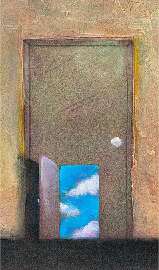
Against this backdrop oceanic for an existentialist to drown in, our writings might as well be paper boats, a desperate contraption and artificial imitation of Noah's Ark through the deluge of our worries and our nightmares about doomsday scenarios straight from the movie “The Day After Tomorrow.” These cataclysms are really redundant when we reckon that these natural calamities are just variations on a trite theme of “man's fall from grace,” or how this flood of human misery is symptomatic and symbolic of a world damned by a tide of intolerance, enmity, and inequity. Where hatred and hunger, poverty and politicians are facts of life that also hint of the state of our cultural state of being. Where estrangement from our moral moorings and a dislocation of our sensibility are a commonplace.
Failure of imagination is a matter we may ascribe to our politicians and policy-makers. But this is something we delude ourselves or hope to believe we are exempt from as we dare to play God with the purging and transformative power of the written word, out of that cloud in our head we call creative writing.
This is one power worth struggling for even as we try to tame this wild and larger-than-life creature called literature, as we stubbornly attempt to discover meaning in life as well as find life in meaning. That meaning might be found as we conscript ourselves to a crusade for our culture, or when steadfastly and stubbornly assert our identity even if such identity is shadowed by forces more formidable than us and threatens to wipe out our singular voice with which we hope to amplify our authentic experience to which we are umbilically linked.
Failure of imagination happens when the terrible things in the world, conspiring to cast a black eye on humanity, defeats us into seeing it with cold jaded eyes and blinking away the spark of wonder out of our gaze that ought to glint with the “pure wisdom of someone who knows nothing,” as Pablo Neruda would put it. To find something out of nothingness or the void as when another poet, Carolyn Forche, stubbornly exclaims: “Only if the dark conceives it must I think of beauty.”
This knowledge I owe from Neruda and Forche matters most to me about writing beyond theories and shifting schools of thought, beyond history and politics, plot and structure, the literal and the symbolic.
Despite the black wind wafting about, everybody needs metaphors to live by, and everyone has the responsibility (especially writers) to create order or a sense of cosmos out of the chaos of human experience, as much as we strive for a construction of harmony in a poem, or an orderly narrative in a reportage, a novel, a story.
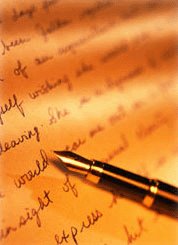 But I agree there is a something much more simple and primitive and elusive that lies at the core of writing that has to do with the mystery of the created world: the need to approach this mystery with fear and loathing, at first, and finally with hope.“Eventually one must put aside the paradoxes and the explanations and simply write,” averred a novelist.
Failure of imagination, that's something we can not blame on Cseslaw Milosz who referred to his poems as "bearing witness both to the natural wonders of the earth and the demoniac doings of history in the 20th century." That's something we can not accuse Octavio Paz of, as he devotes himself to the idea that poetic activity is revolutionary in nature, convinced that creative writing is an operation capable of changing the world. Writing, he swears, is both "a means of internal liberation and also a spiritual exercise."
Creative writing, after all, can only be an act of faith, of hoping against hope. That, indeed, something can still be saved. That something left for dead, like our marginalized culture and literature, can still be resurrected.
Though our voices may spawn a howling wilderness of disquiet and questions, it's comforting that there's a coda in the Eucharist that ought to be echoed as the bottomline of our bylines: “We remember. We celebrate. We believe.”
 (In time for Lent, here's a reprint of my latest column from the opinion page of Sun.Star Cebu)
UPTOWN, JUST a bell’s ring and a sermon away from the Sacred Heart Church and the Iglesia ni Cristo, is a nightspot downright definite about its business. Club Temptation, entices its neon sign flaunting a silhouette of a naked woman.
Not that there’s something off tangent about a honky-tonk hole in the wall existing smack where droves of devotees gather to celebrate their faith. Goodness, after all, doesn’t define itself from an immaculate void. Or, a background of pure whiteness— the absence of color— against which the screaming streaks of black or red would be more vivid.
No happenstance in this Holy Week, therefore, is the courage and humility to embrace our imperfections and our indiscretions— these birthright of sin that shine in spite of God’s blueprints for us to be “divinities in disguise.” To welcome our badness home, as the poet Stephen Dobyns affirms. Only then can one shove it out the window, true. Inasmuch as Christ himself receive and gather us all in a gesture of openness, his outstretched hands nailed on the cross, issue an open invitation to sinners or saint-wannabes – a take-it-or-leave-it offer for either eternal salvation or damnation.
Redemption, that’s one thing that looms like a fist at the moon. Or, a pie in the sky over a fallen planet where politicians, terrorists, power-famished scientists and fame-obsessed celebrities play god. As intolerance and inequity make the world go round even on the brink of a nuclear meltdown and the woebegone weather all over the globe in the aftermath of the greenhouse effect, the longing gaze for deliverance remains as steadfast as the search for the Holy Grail.
While evil is inescapable, perhaps no temptation is more potent in its spell than the seduction to shrug off and get swayed into the ease of cynicism. No scruple, no moral muscle to flex in the face of despair.
Indeed, as politicians and policy-makers (with 30 pieces of silver swallowed all the way down their sphincters) remain blessed with the survival skills of rats and vultures, betrayals of all society’s cherished values will continue to gnaw at the edges of our belief in goodness, in sweetness and light.
Regarding the night as a constant of the human condition, William Stafford waxes mystical. “The darkness around is deep,” he warns. Then again, echoing another poet’s oft-stated exhortation to “rage, rage against the dying of the light,” Stafford is obdurate about an objective of vigilance. “For it is important,” he intones, “that awake people be awake.” Or else, “a pattern that others made may prevail in the world/ And following the wrong god home we may miss our star.”
Either that, or the wonder of it all underscored against all odds by this testament of faith: “Dying He destroyed our death…”
Today, in the shadow of the crucifixion, a more lasting temptation endures and persists to tease the imagination. Pray tell what else can beat the inevitability of an Easter Sunday?
SNAPPY SNIPPETS FOR THE SPIRIT
 TIMELY for Holy Week and beyond, here's something fished out of the Web-- a few morsels of reminders more than enough to dredge up deeper hungers and have a spiritual burp:
1) Give God what's right-- not what's left.2) Man's way leads to a hopeless end-- God's way leads to an endless hope.3) A lot of kneeling will keep you in good standing.4) He who kneels before God can stand before anyone.5) In the sentence of life, the devil may be a comma-- but never let him be the period.6) Don't put a question mark where God puts a period.7) Are you wrinkled with burden? Come to the church for a face-lift.8) When praying, don't give God instructions-- just report for duty.9) Don't wait for six strong men to take you to church.10) We don't change God's message-- His message changes us.11) The church is prayer-conditioned.12) When God ordains, He sustains.13) Warning: Exposure to the Son may prevent burning.14) Plan ahead-- It wasn't raining when Noah built the ark15) Most people want to serve God, but only in an advisory position.16) Suffering from truth decay? Brush up on your Bible.17) Exercise daily-- walk with the Lord.18) Never give the devil a ride-- he will always want to drive.19) Nothing else ruins the truth like stretching it.20) Compassion is difficult to give away because it keeps coming back.21) He who angers you controls you.22) Worry is the darkroom in which negatives can develop.23) Give Satan an inch & he'll be a ruler.24) Be ye fishers of men-- you catch them & He'll clean them.25) God doesn't call the qualified, He qualifies the called.26) Read the Bible-- It will scare the hell out of you.
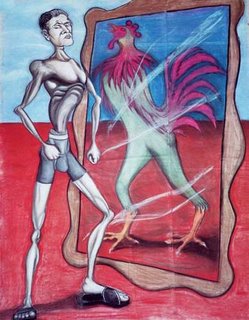 HYPOCRISY and the temerity to flaunt one's impoverished imagination-- which the Cebu City Council has been wearing on its sleeves lately-- got me riled up in my column at the opinion page of Sun.Star Cebu (28th of March, 2006). Read on:
Stand Up and Deliver
Show me a man who wears his contentment like second skin, and I’ll show you someone man enough to laugh. Chances are, he might as well be the other side of a cuddly twosome chuckling their way beyond orgasm. Which makes me wonder where goes the humor of the male-dominated Cebu City Council. Why so grumpy, sirs? Didn’t you hear it said that sexually fulfilled fellas are often spared from waking up at the wrong side of the bed? Lately, it does seem as though some of our Councilors have been impotent about expressing amusement. Which is sorely needed, come to think of it, in the wake of that below-the-belt reality check from the Asian Institute of Management shutting out our Queen City of the South from among the country’s Top Five cities. That, especially for those with a wet dream about the city’s supremacy, is enough to make one go limp between the legs. Roll their eyeballs, the councilors do as they raise their hackles against a print advertisement pitching for Penrex herbal capsule. Meant for those suffering erectile dysfunction, the ad offers a picture-perfect example on how to tease the imagination. It shows a bespectacled, naked male bowing his head in discontent while holding and covering his private parts with a cardboard showing a bulldog dozing off. But so extra alert are the councilors- most of them in their late 40s and obviously downhill from their roll-down-the-hay days- to fancy foulness, finding the promotional pitch as “offensive to morals” and “goes beyond the Filipinos’ line of decency.” You bet, they’re not joking!  It fails to demonstrate social responsibility, grumbles Councilor Arsenio Pacaña thumbs down the advertisement in a resolution the Council has approved. As if a capsule with a modest intent to ease sexual discontent ought to also energize the taker to spray his seeds, for instance, in ecological crusades for Mother Earth. Hey, how about suggesting to Penrex merchants to package their capsule in such a way that it would be a contender for the print category of the Catholic Mass Media Awards? Claim, for instance, that an intake of Penrex would make one more robust about their civic duties as a citizen. Or, how about promising outright that this capsule is all it takes to stand up and deliver? If so, that would make Penrex irresistible even to the councilors themselves who certainly needs all the help they can muster to propel our city back on top. If that happens, surely our councilors would have more reason to be cheerful. Hopefully, they will take their cue from another full-page advertisement-- a birthday greeting for a Cebuano congressman flaunting his list of achievements. Such display of self-gratification may smack of obscenity to some. But the congressman, raising the hand of Manny Pacquiao-- the epitome of virility to many-- at least looks genial with a grin. There may be other reasons, aside from his political success, why he isn’t frowning.
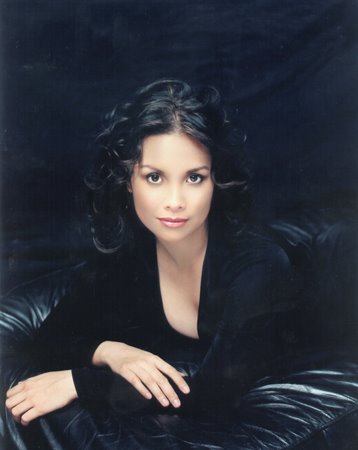
From the posting of Ron Maceda, a Noranian, in an e-group composed of the Superstar's fans: Last night, the international star proclaimed on national TV that Nora Aunor is a genius actress and a
 great singer. Lea guested on Loren Legarda's Real Stories aired every Friday on Channel 5.Asked if any local star gets her starstruck, Lea candidly answered: "Nora Aunor."The Tony awardee admitted to having watched some of the Superstar's films on TV and professed her admiration for her acting style. "There's this one movie scene where Nora's face seemed blank. And only her eyes were acting," she said. "I was impressed. I remember saying to myself: that woman is a genius!... And she's a great singer, too."
COMING TO TERMS with the cold, with its dark undertones, has been constant in my poetry. Here are variations on the theme, with a bit of revision since it first saw print on the pages of Philippine Graphic (8 April 1996) and the anthology Likhaan: Best of Philippine Poetry and Fiction 1997 (UP Press).ALL THE UNSUNG 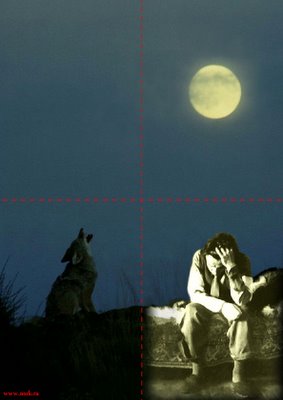 They come wind-
willed, without a creak
from the rusty gate.
Those who went
are here again, shouting
for their shadows.
My breath clouds over
everything when I
call back. No more
the barking dogs. I
swing the windows wide
and wonder why
the sky lately looks
starved of stars. I
gather myself,
cold. I hear nothing
but birdbone stuck in
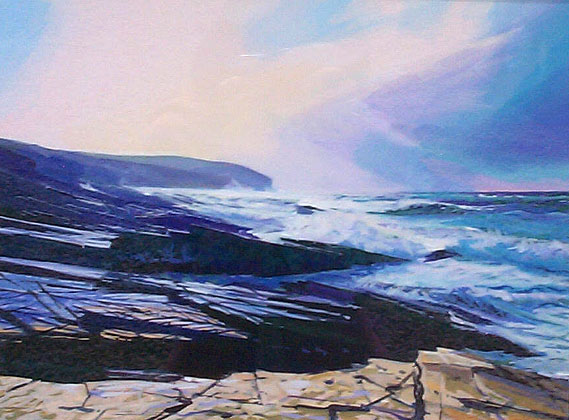
the wind's throat.SPECKS OF SEAI I remember, and the breathing of the drowned draws the ripples.
The waves drowse no more,
wobbling the boat while the wind
blows out the weathered hats
of fishers. I stand wordless at
the breakwater's edge and hear
the burst of spume. Storms recur
in my head. Now returns all
the shipwrecked. All the dead. 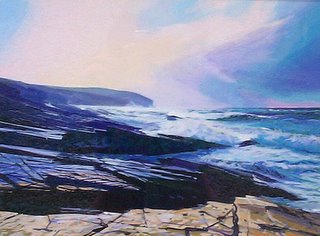 II
II
Flitting by are swarms of fishes.
In the coral within my skull skulks
the coelacanth and I, diving
deeper, peer at it, prying it loose.
As it surges off, unhooked,
my depth-deafened ears hear
the scabrous clarity of scales. I blink,
resurfacing in the eye of the surfs.
Only the remora remains, mossy
in the rustling waters of memory.
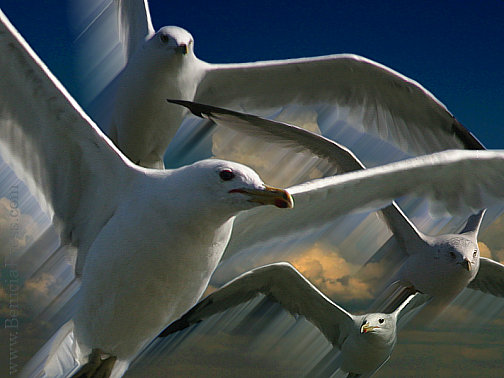
ADDRESSED TO A NAMELESS MARINER This is just to say how I envy the sea  gulls. Theirs is the blue of both sky and water
in one fell swoop while all I can see
are but the odds and ends of leavings: fishbones,
a litter of shells, stranded sargasso... Your bottled
letter found me among these ebbtide
souvenirs. On this usual shore. I stumbled,
tripping over it. Now I know the wind's a guide,
goading the waves on until even my feet
wavered, as when I hurled this missive, this
reply folded like a wing. May air ripple through it
like a sigh. This is just to say goodbye.
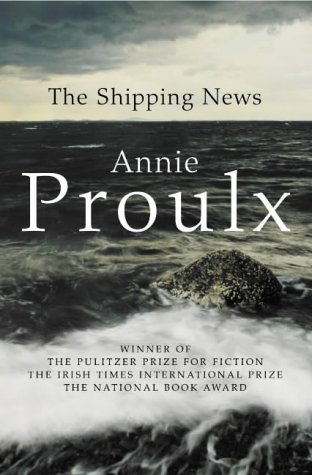
From E. ANNIE PROULX's The Shipping News: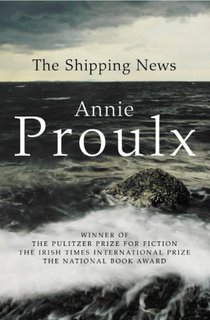 "One of the tragedies of real life is that there is no background music.":::"And what we fear we often rage against." :::"... he was wondering if love came in other colors than the basic black of none and the read heat of obsession.." :::"Was love then like a bag of assorted sweets passed around from which one might choose more than once? Some might sting the tongue, some invoke night perfume. Some had centers as bitter as gall, some blended honey and poison, some were quickly swallowed. And among the common bull's-eyes and peppermints a few rare ones; one or two with deadly needles at the heart, another that brought calm and gentle pleasure. Were his fingers closing on that one?":::
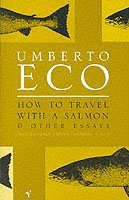
"... we are only passing by. We only walk over these stones a few times, our boats float a little while and then they have to sink. The water is a dark flower and a fisherman is a bee in the heart of her." From UMBERTO ECO's How To Travel With a Salmon and Other Essays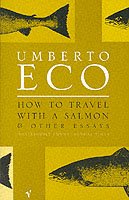 "The mass media first convinced us that the imaginary was real, and now they are convincing us that the real is imaginary; and the more reality the TV screen shows us, the more cinematic our everyday world becomes. Until, as certain philosophers have insisted, we will think that we are alone in the world, and that everything else is the film that God or some evil spirit is projecting before our eyes." (How To React To Familiar Faces)
:::"A writer is someone determined to extend language beyond its boundaries, and he therefore assumes full responsibility for a metaphor, even a daring one." (How To Use Suspension Points):::
"It is enough to tell the truth. Naturally, truth comes in all sizes." (How To Write An Introduction To an Art Catalogue) :::"Human beings have always been merciless with animals, but when humans become aware of their own cruelty, they began, if if not to love animals (because, with only sporadic hesitation, they continue eating them), at least to speak well of them. As the media, the schools, public institutions in general, have to explain away so many acts performed against humans by humans, it seems finally a good idea, psychologically and ethically, to insist on the goodness of animals. We allow children of the Third World to die, but we urge children of the First to respect not only butterflies and bunny rabbits but also whales, crocodiles, snakes. Mind you, this educational approach is per se correct. What is excessive is the persuasive technique chosen: to render animals worthy of rescue they are humanized, toyified. No one says they are entitled to survive even if, as a rule, they are savage and carnivorous. No they are made respectable by becoming cuddly, comic, good-natured, benevolent, wise, and prudent... Simply put, we must love-- or, if that is downright impossible, at least respect-- these and other animals for what they are. The tales of earlier times overdid the wicked wolf, the tales of today exaggerate the good wolves. We must save the whales not because they are good, but because they are part of nature's inventory and they contribute to the ecological equilibrium. Instead, our children are raised with whales that talk, wolves that join the Third Order of St. Francis, and, above all, and endless array of teddy bears." (How To Speak of Animals)
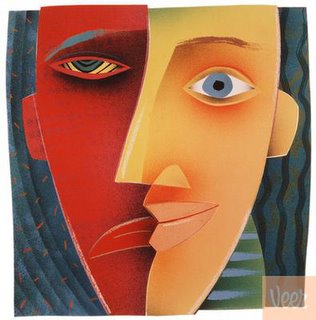 WHAT MAKES US TICK as a people may make some of us feel sick. So goes the crux of my column tomorrow in Sun.Star Cebu: It's as awry as a sore thumb sticking out, but mirth in the face of misery is one peculiarity so patently Pinoy. Absurd enough, true, to baffle even the Greeks who symbolized theater as a tragicomic pair of masks.
Consider, for instance, those television footages straight from an accident or crime scene. See how the reporter intones the ill-starred subject of the story while a bustle of kibitzers at the background jostles for their fair share of the camera, waving and winking or striking a chin-up pose worthy of Mr. Suave. That happened, yes, in the wake of the Wowowee stampede. A grinning face or two, that’s also starkly visible in the front-page photo of the Philippine Daily Inquirer yesterday counterpointing the utter despair of those waiting for upbeat possibilities about survivors in the Southern Leyte landslide.
Here’s where the Grim Reaper seems to have trouble with being taken seriously. As if tragedy were a freak force of nature, a pratfall or an outlandish piece of rumor out of a clown’s lopsided mouth.
In this grin-and-bear-it country where stand-up comics are more compelling than politicians and where cartoonists can best interpret our socio-economic state, being hapless is something most of us endure with unbearable lightness. As if, on the heels of man-made or natural disasters with a ho-hum rate of recurrence, yet another sorrow can be shrugged off thus, “So what else is new?”
Be merry today, tomorrow is another sloppy trick up a freak’s sleeve. Or so many of us with a happy-go-lucky binge seem to believe. Recall a recent article from Time Magazine, explaining why Filipinos consistently top national happiness surveys compared with the rest of the world despite poverty, calamities and countless other reasons to wallow in the slough of despond. We can even die laughing.

We’re gracefully tough as the bamboo, true. We suffer fools gladly, and we can win Olympic medals if being easily amused and self-sufficient were up for competition.
"Around the world, people are searching for happiness,” writes Alan C. Robles. “For Filipinos, happiness isn't a goal: it's a tool for survival.”
The Flintstones might as well be Filipinos, who knows?
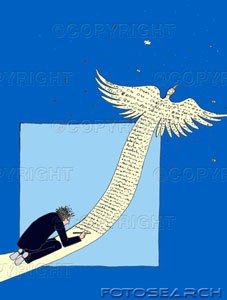 DON'T WORRY, WRITE POETRY. And be happy. That, in a nutshell, is the eyebrow-raiser out of the Independent Online Edition written by Christina Patterson. Read on:
Poetry is good for your health. That, at least, is the premise of studies currently under way for the Arts Council and the Department of Health. One study, published a couple of years ago in the journal Psychological Reports, suggested that writing poetry boosted levels of secretory immunoglobin A. Another, undertaken by a consultant at Bristol Royal Infirmary, concluded that poetry enabled seven per cent of mental health patients to be weaned off their anti-depressants. Poetry, it seems, is not the new rock'n'roll, but the new Prozac.
This was not instantly evident at the ceremony for the TS Eliot poetry prize last week. Perhaps it was the strip-lighting, but the assembled throng of pasty faces and panda-shadowed eyes did little to foster a sense of radiant health. As feel-good events go, it ranked just above a tussle with your online tax return, but probably below a Thai takeaway in front of Celebrity Big Brother. It was, of course, not fair of Cyril Connolly to describe poets as "jackals fighting over an empty well", but it is true that £10,000 prizes do not, on the whole, boost the health and happiness of those who don't win. 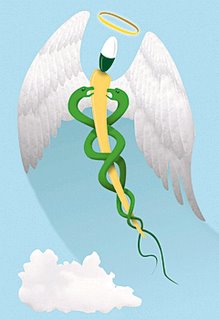 The prize, in any case, went to a paean to psychosis. Carol Ann Duffy's collection of love poems, Rapture, is a moving and, at times, skin-crawlingly accurate portrayal of a process that psychologists have recently identified as a form of madness. We have all been there: tending the mobile "like an injured bird", repeating the name "like a charm, like a spell". For most of us, falling in love is a season in what Duffy calls "glamorous hell", and not a sojourn. We might suffer a few sleepless nights, or even eat a bit less than usual, but we can't sustain life at this pitch. And, luckily for us, our minds comply.
Many poets - a higher proportion, apparently, than of the average population - are not so lucky. John Clare, Anne Sexton, Robert Lowell and, most famously, Sylvia Plath, all knew the torments of a mind that would, on occasion, burst out of the crucible of what Freud called "normal human misery" into the nameless horrors of mania. The mad poet may be a cliché, but it is not a myth. Poets continue to write of their experiences of mental illness. If poetry is some kind of wonder-drug, it sure ain't working for them.So who is making these headline-hitting assertions, and why? The answer, of course, is arts administrators, and they're doing it for money. And kindness, and the philanthropic impulse, and passion and a desire to help the lost and the lonely and the miserable and the mad. But, to do all this, you need money, and to get money you need to go to funders, and to go to funders you need studies, evidence, and results.
A current project is a good example. Poems in the Waiting Room was set up by an enthusiastic 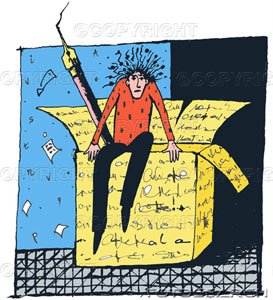 social worker eight years ago. Run, like most of these things, on a shoestring, it has had little pots of funds from trusts and foundations as well as the Arts Council, the Poetry Society and the Foreign Office. It aims are, you'd have thought, worthy and modest: to cheer up miserable places (hospital waiting rooms) at an anxious time with a little injection of art.Their online "evaluation," however, tells a different story. Amongst a dizzying range of aims and objectives listed in its executive summary are "to gauge the external consequences of displaying poems in waiting rooms", to see "what new behaviour follows" and "what new activities". An extensive discussion of the "methodology" follows, with tables of facts and figures. The one thing, in fact, that the project doesn't allow for is for someone to read a poem and keep quiet about it. This is poetry as life-coaching. You must read and act and reach your goal. And you must do this in an act of self-improvement in which most poets, critics and readers have failed.
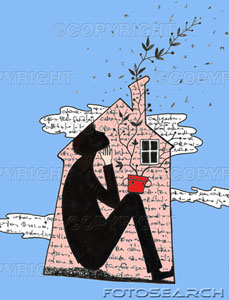 In a brave moment of honesty and bathos, the project's organisers assert that "the precise impact of the poems displayed... was always going to be hard to measure". The final report consists, as these things always do, of pages of anecdote masquerading as science, and ends with the hope that further funding be found. My heart went out to the organisers. Like most of us, they're simply doing their best in a league-table culture where everything is judged by results.
There is, in the right hands, a fine role for poetry as social work, but let's not pretend that it's the same as poetry as art. Poetry, like all art, is not a panacea. Perhaps it's more like homeopathy. A great placebo - some people swear by it - but the studies are inconclusive.
 MY WIFE ARLAINE, teasing as ever, asked me yesterday if I have anything romantically surprising for her today. Lemme see, I winked. Last year, we spent our Valentine's Day trying to steer clear from the stampede of lovers out for a candle-lit dinner. So we deemed it more spectacular to hie off at the sidewalk near the Fuente Osmeña park. There, she could only chuckle as she watched me wolfing down a burpful of balut, my lips sluicing vinegar and salt. Less costly, less cliche.
Today, I risk getting a frown from her as I resort to going back to the basic, setting out to bring her a bouquet of orange and purple mums and a box of heart-shaped chocolates in motley colors. Trite, the mother of my two sons will tell me. But, as I'll retort with yet another wink, I know she'd hum along when I'll breeze through bits of a hackneyed song: The fundamental 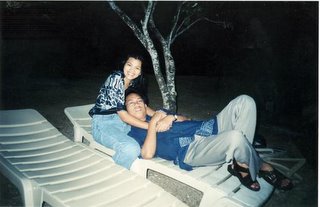 things apply as time goes by...
And I will tell her, too, the words still hold true out of this first poem I wrote for her six years ago:
MUSING MY ONE TRUE POEM
Unless you come into me,
I have only the heart
of a blank page. The 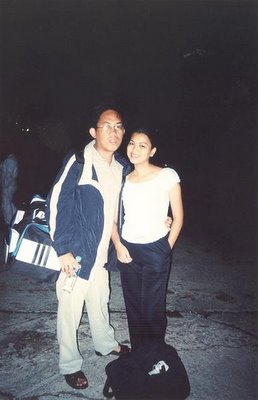 beat
beat
of metaphors tapping limp as the feet
of rain in the desert. The wreath
of smoke out of mirrors. The breath
of me disfigured of speech, spitting
shards or forking the words like a snake
from the pit of my tongue.
Until my touch becomes your second skin,
nothing can break you open or spurt
the seed of my silence into fruiting
the phrases only bees
and worms embrace. In the absence of words.
In the scent of flowers. In the flesh
of dreams where the dead can
teach me: To read with all ears the dance
of the shovel in a patch of paper
where a gardener burns the weeds
and a gravedigger whistles until
I can fill all that's hollow
and come into you.
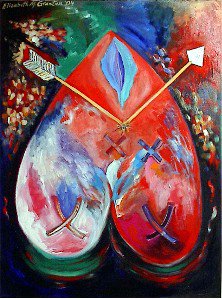 WHAT'S LOVE IF it's not something to die or kill for?
On a day like this, when the air is suffused with sweetness and light while the call of commercialism whittles down the wilderness of the heart to a cozy cage of sentiments, passion is often given a short shrift. As if it were devoid of violence out of a wrenching away from the self-centered zone of comfort. As if its beauty and tenderness weren't always threatened by danger or pain and fear of losing.
Methinks nothing's worth loving unless it spawns inside us a ruthlessness to be reckless in pursuit of our private Eden. Yes, not until it smolders enough to ignite in us a purging compulsion to endure burning. Ah, that feeling of being killed softly. Something that most love songs gloss over, sad to say.
Against the overchewed and junk-food notions of romance, here's my poem slightly revised since its publication at the Sunday Inquirer Magazine (August 27, 2000) :
PRANDIAL PIECES
I'm at your banquet because wolves
are invited, hoping your heart
is on the plate.
A toast startles you. As if stars,
falling, shattered the wine glass
you're holding.
I'll wash with the wine your bloodied
hand until your eyes suffice
to drown me.
You say the dishes are almost cold.
I reply with a burp. Suddenly,
the knife drops.
A rodent slurps on my vomit. All I care
of etiquette is when hunger devours
the heartbeat.