The more blogs change, the more they remain... Still here, but I hope we'd see each other more often there for my latest posts.
Showing posts with label blogging. Show all posts
Showing posts with label blogging. Show all posts
Tuesday, November 25, 2008
This blog has moved to "Run the Rays" (www.brewingmyke.blogspot.com)
The more blogs change, the more they remain... Still here, but I hope we'd see each other more often there for my latest posts.
Wednesday, April 30, 2008
Who in the world are we?
 We're all alone, avers a song. But now that connectivity is just at the tip of our fingertips in this Age of the Internet, isolation takes a common and ironic turn.
Along that line goes the gist of one of my recent columns "So To Speak" in the op-ed page of Sun.Star Cebu (April 24, 2008). Hereunder is the reprint:
Sharing our story
BLOOD boiled up to their eyes. Upset by the ugly comments about them in their classmate's blog, eight high school students in Florida are now facing charges after they reportedly battered the poor young lady and left her almost unrecognizable.
Such blind rage, indeed, after they felt belittled in her MySpace page. What an oversight for her as well to have raised an eyebrow, looking for trouble by seeing other people in a bad light. In the netherworld of “nada” where one is degraded or rendered insignificant, invisible.
Who wants to be written off into the ignominy of anonymity? Not those who admitted to have Googled themselves at some point in their lives. They comprise almost half of the respondents (47 percent) in a recent survey by the Pew Internet and American Life Project that aims "to produce reports that explore the impact of the Internet on families, communities, work and home, daily life, education, health care, and civic and political life."
One's sense of self, in this age of Net surfing, can either sink or stay above water. "I Google myself to see what kinds of waves my life is making in the world," affirms travel writer Frank Bures in the latest edition of Poets and Writers Magazine. "Isn't that why writers, artists, and other egomaniacs obsess over the Amazon ranking of their book, the comments on their blogs, the hits on their websites?"
 Almost desperate, what seems an emergency to make our presences felt—upending our universal isolation---in the grand scheme of technology. In this digital world, the democracy of bloggers and YouTube uploaders means never having to say sorry. Particularly in a pell-mell attempts at autobiography, a puny and slapdash binge at shaping some moments—no matter how trivial, or utterly devoid of larger-than-life hallmarks of heroism—against the flux called history.
Never mind if one can't cast one's words in gold with the touch of a Resil Mojares, who laments the lack of memoirs and autobiographies. "Since people do not leave behind written accounts of their lives, we miss out on a lot of the personal, human details of how larger histories are made," explains Mojares at the book launching of "Shapes of Memory," the biography of Cebuano labor leader and trade unionist Democrito T. Mendoza.
Sweat the small stuff, baby. "Little things can lead you to big events…," attests Mendoza, explaining the necessity "to write the details of his life…to encourage young people to face challenges and be ready to risk everything to achieve a better life." For a broad base of contacts, Mendoza might try to open a Multiply account.
Uploading himself at YouTube for a wider audience of his inspiring tale, however, might be a strain for him. He won't stand a chance, no matter how noble he is, compared to the almost extra-terrestrial dimensions of human condition shown in the unlimited scope of its videos.
It's where one can spot, for instance, a perfume canister stuck into someone's rectum. And how the victim ends up literally the butt of jokes, sprawled in the surgery room as the cameras zoom into the twilight zone of his anatomy. Behold the sharp edges of laughter cutting him to pieces, piercing us who witness into complicity. So much for a shared story.
Thursday, July 27, 2006
Let There Be Flight
Houdini hours. That's what I call those spells of wonder at the edge of awareness when words soar above the hubbub between sleep and death, striving for a consciousness uncaged.
 That happens when I morph into a figurative fugitive after being caught up in the sundry details of insignificance with which the days pass us by, as if everything were merely a matter of happenstance. Yes, hapless ever after like dust in the heels of us carelessly passing through.
Still a fledgling in Poetry after 12 years so far of pursuing the birdcall of this "most sullen and solitary of art," I have been at a loss over some of my pieces too elusive to stay, resisting to be gathered as keepsakes of my greenhorn flights of fancy. As if they refused to be caged or be fixed like dead butterflies framed up on a wall. Where have all those poems gone?
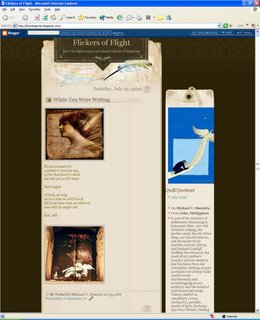 Painstakingly, and even if a lot of my literary attempts often leave me flushed in the face while I wince and squirm under my skin, I have plucked out some that have refused to be towed out of my reach, stuck somewhere where I tucked them pell-mell, gathering dust and the smell of forgetting.
For better or for worse, I intend to keep these as mementos of those moments that stretch eternal out of "the white walls of silence," when my cowlick fluttered cloudward as I ventured my own version of being an escape artist out of the fetters-- tritely does it-- of merely skimming over the surface, in search of meaning and its presences.
With your indulgence, allow me to invite you to my new blog for my poetry in English: Flickers of Flight (http://brewingmyke.blogspot.com). Ayu-ayo!
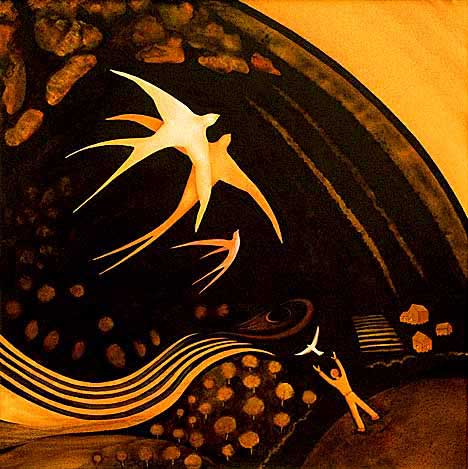 That happens when I morph into a figurative fugitive after being caught up in the sundry details of insignificance with which the days pass us by, as if everything were merely a matter of happenstance. Yes, hapless ever after like dust in the heels of us carelessly passing through.
Still a fledgling in Poetry after 12 years so far of pursuing the birdcall of this "most sullen and solitary of art," I have been at a loss over some of my pieces too elusive to stay, resisting to be gathered as keepsakes of my greenhorn flights of fancy. As if they refused to be caged or be fixed like dead butterflies framed up on a wall. Where have all those poems gone?
 Painstakingly, and even if a lot of my literary attempts often leave me flushed in the face while I wince and squirm under my skin, I have plucked out some that have refused to be towed out of my reach, stuck somewhere where I tucked them pell-mell, gathering dust and the smell of forgetting.
For better or for worse, I intend to keep these as mementos of those moments that stretch eternal out of "the white walls of silence," when my cowlick fluttered cloudward as I ventured my own version of being an escape artist out of the fetters-- tritely does it-- of merely skimming over the surface, in search of meaning and its presences.
With your indulgence, allow me to invite you to my new blog for my poetry in English: Flickers of Flight (http://brewingmyke.blogspot.com). Ayu-ayo!
Saturday, July 15, 2006
Viva Bisdak!
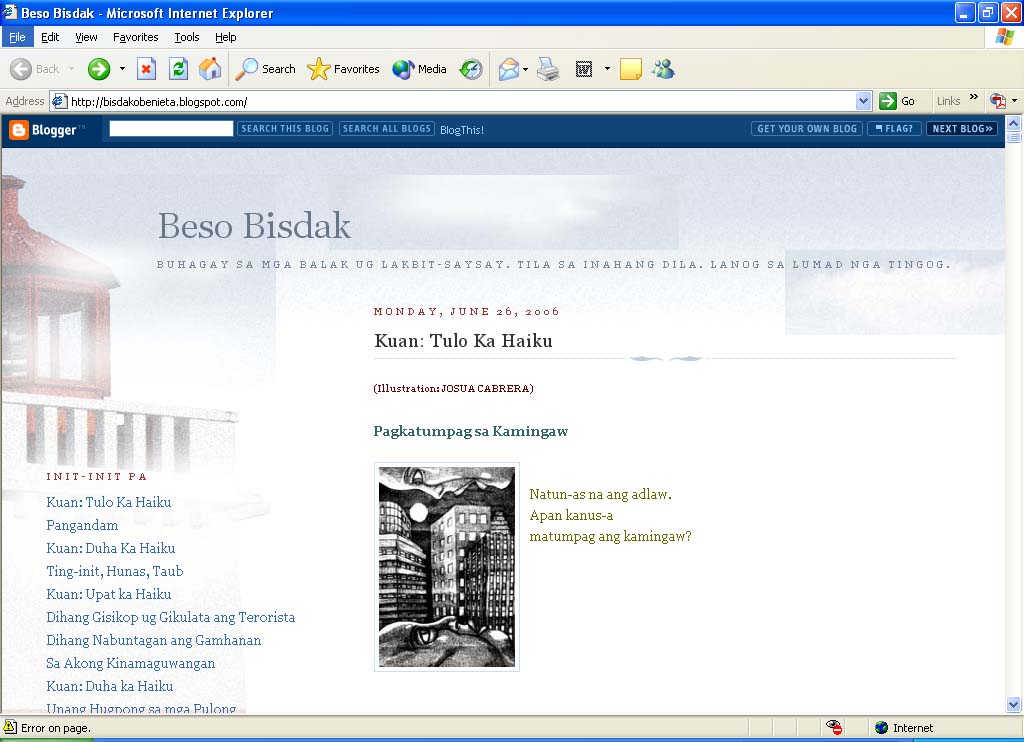 GO KICK me with this shamelessly indulgent tidbit, and I don't mind at all if you take it with a lemon-twisted grain of salt.
It doesn't happen all the time, anyway: one's blog being chosen Cebu Site of the Fortnight (July 15 - July 31, 2006).
Bitaw bay, Wa'y Blima! Cebu (the leading web portal to Cebu) has singled out Beso Bisdak-- my online cauldron of creative writing in Cebuano-- "selected from the Cebu Web Directory on the basis of criteria such as quality of content, design, and relevance."
And all the while I thought only a stray cat gives a rat's tail of a chance to bother about anything that reek of Cebuano.
 Therefore, allow me in gratitude to pay the previlige forward by recommending another site by a fellow who rocks and rolls with his Bisdak identity.
He needs no intro, my colleague Insoy whose band (Missing Filemon) has been at the rears and flanks of this tsunami in the local music scene. "Bisrock," it's called. Right off the bat, that's the talking point as Insoy's blog Insoymada launches a new section in Q-and-A format.
It's where Insoy keeps "important "conversations" with people and friends whose opinions matter, and those whose opinions are so trivial that they matter." For the maiden interview, my friend Januar Yap (who coined the word Bisrock) takes the bloglight. Na hala, padayon, labyog Bisdak!
Wednesday, May 10, 2006
Blogosphere Blues
WHEN BLOGS RULE, we'll all talk like... Thus Daniel Henninger, deputy editor of Wall Street Journal, waxes elliptical in his article titled, "Disinhibition Nation." Here's more than meets your rolling eyeballs:
 Kevin Ray Underwood, the repressed Oklahoma cannibal, kept an Internet "blog" of his compulsions for years before kidnapping and killing a 10-year-old neighbor last week. On his blog, Kevin wrote a lot about Kevin: "The reason for my lackluster social life is a severe case of social anxiety and depression. I'm on medication now, which helps a lot. Well, in ways."
I don't think the blogosphere is breeding cannibals. But it looks to me as if the world of blogs may be filling up with people who for the previous 200 millennia of human existence kept their weird thoughts more or less to themselves. Now, they don't have to. They've got the Web. Now they can share.
Technorati, a site that keeps numbers on the blogosphere, reports that as of this month the number of Web logs the site tracks is 35.3 million, and doubling every six months. Technorati claims each day brings 75,000 new blogs. We know something's happening here but I'm not sure we know what it is.
Typically, a blogger creates a Web site and then, in the pale glow of a PC screen, types onto a keyboard what's on his or her mind. A blog nearly always invites readers to share their "comments," which they do, and which the blogger posts seriatim. People in my business tend to think blogging is mostly about politics on sites such as Wonkette, the Huffington Post or the Daily Kos. There are highly intellectual blogs, such as the Becker-Posner Blog, run by Nobel economics laureate Gary Becker and federal judge Richard Posner. Their April 16 post is titled "Tax Complexity and the Cost of Compliance," with comments.
But in a "Blogs Trend Survey" released last September, America Online reported that only 8% blog to "expose political information." Instead, 50% of bloggers consider what they are doing to be therapy. Some might argue that using the Internet to self-medicate includes many nominally political blogs, but more on that shortly.
Not surprisingly, a new vocabulary has emerged from clinical psychology to describe generalized patterns of behavior on the virtual continent. As described by psychologist John Suler, there's dissociative anonymity (You don't know me); solipsistic introjection (It's all in my head); and dissociative imagination (It's just a game). This is all known as digital identity, and it sounds perfectly plausible to me.
A libertarian would say, quite correctly, that most of this is their problem, so who cares? But there is one more personality trait common to the blogosphere that, like crabgrass, may be spreading to touch and cover everything. It's called disinhibition. Briefly, disinhibition is what the world would look like if everyone behaved like Jerry Lewis or Paris Hilton or we all lived in South Park.
Example: The Web site currently famous for enabling and aggregating millions of personal blogs is called MySpace.com. If you opened its "blogs" page this week, the first thing you saw was a blogger's video of a guy swilling beer and sticking his middle finger through a car window. Right below that were two blogs by women in their underwear.
 In our time, it has generally been thought bad and unhealthy to "repress" inhibitions. Spend a few days inside the new world of personal blogs, however, and one might want to revisit the repression issue.
The human species has spent several hundred thousand years sorting through which emotions and marginal neuroses to keep under control and which to release. Now, with a keyboard, people overnight are "free" to unburden and unhinge themselves continuously and exponentially. One researcher quotes the entry-page of a teenage girl's blog: "You are now entering my world. My pain. My mind. My thoughts. My emotions. Enter with caution and an open mind."
The power of the Web is obvious and undeniable. We diminish it at our peril. But what if the most potent social effect to spread outward from the Internet turns out to be disinhibition, the breaking down of personal restraints and the endless elevation of oneself? It may be already.
Disinhibited vocabulary is now the normal way people talk on cable TV, such as on "The Sopranos" or in stand-up comedy. On the Web and on the street, more people than not talk like this now. What once was isolated is covering everything. No wonder the major non-cable networks are suing to overturn the FCC's decency rulings; they, too, want the full benefits of normalized disinhibition. Hip-hop, currently our most popular music form, is a well-defined world of disinhibition.
Then there's politics. On the Huffington Post yesterday, there were more than 600 "comments" on Karl Rove and the White House staff shake-up. "Demoted my --- the snake is still in the grass." "He should be demoted to Leavenworth." "Rove is Bush's Brain, and without him, our Decider-in-Chief wouldn't know how to wipe his own ----."
From a primary post on the same subject on the Daily Kos, widely regarded as one of the most influential blogging sites in Democratic politics now: "I don't give a ----. Karl Rove belongs in shackles." "A group of village whores have taken a day off to do laundry."
Intense language like this used to be confined to construction sites and corner bars. Now it is normal discourse on Web sites, the most popular forums for political discussion. Much of this is new. Politics is a social endeavor. The Web is nothing if not "social." But the blogosphere is also the product not of people meeting, but venting alone at a keyboard with all the uninhibited, bat-out-of-hell hyperbole of thinking, suggestion and expression that this new technology seems to release.
At the risk of enabling, does the Internet mean that all the rest of us are being made unwitting participants in the personal and political life of, um, crazy people? As populist psychiatry, maybe this is a good thing; the Web allows large numbers of people to contribute to others' therapy. It takes a village.
But researchers note that the isolation of Web life results in many missed social cues. It is similar to the experience of riding an indoor roller coaster, what is known in that industry as a "dark ride." This dark ride could be a very long one.
 Kevin Ray Underwood, the repressed Oklahoma cannibal, kept an Internet "blog" of his compulsions for years before kidnapping and killing a 10-year-old neighbor last week. On his blog, Kevin wrote a lot about Kevin: "The reason for my lackluster social life is a severe case of social anxiety and depression. I'm on medication now, which helps a lot. Well, in ways."
I don't think the blogosphere is breeding cannibals. But it looks to me as if the world of blogs may be filling up with people who for the previous 200 millennia of human existence kept their weird thoughts more or less to themselves. Now, they don't have to. They've got the Web. Now they can share.
Technorati, a site that keeps numbers on the blogosphere, reports that as of this month the number of Web logs the site tracks is 35.3 million, and doubling every six months. Technorati claims each day brings 75,000 new blogs. We know something's happening here but I'm not sure we know what it is.
Typically, a blogger creates a Web site and then, in the pale glow of a PC screen, types onto a keyboard what's on his or her mind. A blog nearly always invites readers to share their "comments," which they do, and which the blogger posts seriatim. People in my business tend to think blogging is mostly about politics on sites such as Wonkette, the Huffington Post or the Daily Kos. There are highly intellectual blogs, such as the Becker-Posner Blog, run by Nobel economics laureate Gary Becker and federal judge Richard Posner. Their April 16 post is titled "Tax Complexity and the Cost of Compliance," with comments.
But in a "Blogs Trend Survey" released last September, America Online reported that only 8% blog to "expose political information." Instead, 50% of bloggers consider what they are doing to be therapy. Some might argue that using the Internet to self-medicate includes many nominally political blogs, but more on that shortly.
Not surprisingly, a new vocabulary has emerged from clinical psychology to describe generalized patterns of behavior on the virtual continent. As described by psychologist John Suler, there's dissociative anonymity (You don't know me); solipsistic introjection (It's all in my head); and dissociative imagination (It's just a game). This is all known as digital identity, and it sounds perfectly plausible to me.
A libertarian would say, quite correctly, that most of this is their problem, so who cares? But there is one more personality trait common to the blogosphere that, like crabgrass, may be spreading to touch and cover everything. It's called disinhibition. Briefly, disinhibition is what the world would look like if everyone behaved like Jerry Lewis or Paris Hilton or we all lived in South Park.
Example: The Web site currently famous for enabling and aggregating millions of personal blogs is called MySpace.com. If you opened its "blogs" page this week, the first thing you saw was a blogger's video of a guy swilling beer and sticking his middle finger through a car window. Right below that were two blogs by women in their underwear.
 In our time, it has generally been thought bad and unhealthy to "repress" inhibitions. Spend a few days inside the new world of personal blogs, however, and one might want to revisit the repression issue.
The human species has spent several hundred thousand years sorting through which emotions and marginal neuroses to keep under control and which to release. Now, with a keyboard, people overnight are "free" to unburden and unhinge themselves continuously and exponentially. One researcher quotes the entry-page of a teenage girl's blog: "You are now entering my world. My pain. My mind. My thoughts. My emotions. Enter with caution and an open mind."
The power of the Web is obvious and undeniable. We diminish it at our peril. But what if the most potent social effect to spread outward from the Internet turns out to be disinhibition, the breaking down of personal restraints and the endless elevation of oneself? It may be already.
Disinhibited vocabulary is now the normal way people talk on cable TV, such as on "The Sopranos" or in stand-up comedy. On the Web and on the street, more people than not talk like this now. What once was isolated is covering everything. No wonder the major non-cable networks are suing to overturn the FCC's decency rulings; they, too, want the full benefits of normalized disinhibition. Hip-hop, currently our most popular music form, is a well-defined world of disinhibition.
Then there's politics. On the Huffington Post yesterday, there were more than 600 "comments" on Karl Rove and the White House staff shake-up. "Demoted my --- the snake is still in the grass." "He should be demoted to Leavenworth." "Rove is Bush's Brain, and without him, our Decider-in-Chief wouldn't know how to wipe his own ----."

From a primary post on the same subject on the Daily Kos, widely regarded as one of the most influential blogging sites in Democratic politics now: "I don't give a ----. Karl Rove belongs in shackles." "A group of village whores have taken a day off to do laundry."
Intense language like this used to be confined to construction sites and corner bars. Now it is normal discourse on Web sites, the most popular forums for political discussion. Much of this is new. Politics is a social endeavor. The Web is nothing if not "social." But the blogosphere is also the product not of people meeting, but venting alone at a keyboard with all the uninhibited, bat-out-of-hell hyperbole of thinking, suggestion and expression that this new technology seems to release.
At the risk of enabling, does the Internet mean that all the rest of us are being made unwitting participants in the personal and political life of, um, crazy people? As populist psychiatry, maybe this is a good thing; the Web allows large numbers of people to contribute to others' therapy. It takes a village.
But researchers note that the isolation of Web life results in many missed social cues. It is similar to the experience of riding an indoor roller coaster, what is known in that industry as a "dark ride." This dark ride could be a very long one.
Subscribe to:
Posts (Atom)