Showing posts with label books. Show all posts

Wednesday, April 30, 2008

Let there be library

Where on earth do angels delight to hang out? Not inside cathedrals, no! As shown in my most cherished film, Wings of Desire, nowhere else are angels nearer to heaven than under the roof of a library. How they tarry and eavesdrop where silence hums in chorus with the constellation of words between the covers, hovering around readers.

With the recent celebration of the National Library Week (April 13-19, 2008), here's a curtsy to retired Maine librarian Glenna Nowell as she piques public curiosity on books.

Since 1988, Nowell has been writing to celebrities (presidents, actors, athletes and a couple of United Nations secretaries general) to ask and take note of their favorite page-turners. “I was looking for a hook that would get people to read a book,” explains Nowell, who wishes to steer literate folks toward stuffs beyond the bestsellers.

Check out Nowell’s
Celebrity Reading List over the years and take your cue on “Who Reads What?”

~~~ * ~~~
"Some books are to be tasted, others swallowed, and some few to be chewed and digested.”

True to the words of Sir Francis Bacon, 27 culinary bibliophiles in Topeka, Kansas recently whipped up their imagination as sweetly as literally possible. The cake of their creativity took the spotlight at the reception and exhibit of the annual Edible Books Festival last April 4th at the Topeka and Shawnee County Public Library. Up for grabs were prizes for Best in Show, Most Book-Like, and Most Likely To Be Devoured that were chosen by votes from the exhibit’s audience.

While my kids tarried longer in front of the “Cat in the Hat” and “Snowballs” cakes, I slurped over the gothic confection patterned after Edgar Allan Poe’s “The Tell-Tale Heart.”

For more pictures of the entries and the winning edible books, check out the photo album in the library’s website
.

Sunday, October 21, 2007

bookylicious (three days of lust out of the library)


NOW I KNOW what a libertine would feel in a harem. It was a bibliomaniac's wet dream come true when the public library of Shawnee County and Topeka (capital city of Kansas) hauled out its slightly-used books--hardcover and paperback--to the sprawling space of the Kansas ExpoCentre for its annual three-day book sale last month. Whoopee, indeed, as the books were unbelievably cheap (from as low as 25 cents to three dollars!).

Though it was an eye-popping affair taking one's pick from such an orgy of authors, the library's staff and volunteers made the whole shebang in so orderly a manner worthy of a monastery by arranging the books on separate tables according to various genres and classifications. And so despite the throng of readers, it was a breeze to navigate from one book section to another. It was a thrill on the last day of the book sale when all items were for the taking--get all you can--for only three dollars per sack! My wife also had a blast picking up books for our two kids and some health/home therapy manuals.

All in all, I spent only $27 for a stash of magazines (Harper's, National Geographic, Audubon, and Scientific American) and an entire bookcase of a hoard listed below:

Novels

- Paradise (Toni Morrison)

- The Blind Assassin (Margaret Atwood)

- Elective Affinities (Johann Wolfgang van Goethe)

- The Accidental Tourist (Anne Tyler)

- Breathing Lessons (Anne Tyler)

- Searching for Caleb (Anne Tyler)

- The Big Sky (A.B. Guthrie)

- A Sport of Nature (Nadine Gordimer)

- The Mission Song (John Le Carre)

- The Russia House (John Le Carre)

- The Mambo Kings Play Songs of Love (Oscar Hijuelos)

- The Story of Lucy Gault (William Trevor)

- Saturday (Ian McEwan)

- The Hours (Michael Cunningham)

- The Five People You Meet in Heaven (Mitch Albom)

Short Stories

- Cathedral (Raymond Carver)

Poetry/Criticism

- The Poet's World (Rita Dove)

Spirituality

- The Glorious Impossible: Illustrated with Frescoes by Giotto (Madeliene L' Engle)

- Finding God in the Garden: Backyard Reflections on Life, Love, and Compost (Rabbi Balfour Brickner)

Memoir/Biography

- Boyhood: Scenes From a Provincial Life (J.M. Coetzee)

- In the Company of Writers: A Life in Publishing (Charles Scribner)

- Another Life: A Memoir of Other People (Michael Korda)

- Makers of the Modern World: The Lives of Writers, Artists, Scientists, Philosophers, Composers, and Other Creators Who Formed the Pattern of Our Century (Louis Untermeyer, editor)

- War Letters: Correspondence From the American Civil War, World War I and II, the Cold War, Korea, Vietnam, the Persian Gulf, Somalia and Bosnia (Andrew Carroll, editor)

- Great Biographies: Elizabeth I, Charles Darwin, Martin Luther, Mark Twain, Charles Lindbergh, Florence Nightingale, Thomas Edison, Hans Christian Andersen, P.T. Barnum, Pearl S. Buck, Adolf Hitler, John Quincy and Louisa Adams (Reader's Digest series)

Essays/Non-Fiction

- Arctic Dreams: Imagination and Desire in a Northern Landscape (Barry Lopez)

- A Stay Against Confucion: Essays on Faith and Fiction (Ron Hansen)

- A Circle of Quiet (Madeliene L'Engle)

- Face To Face: A Reader in the World (Lynne Sharon Schwartz)

- Enough's Enough... And Other Rules of Life (Calvin Trillin)

- At Large (Ellen Goodman)

- The Rising George: America's Master Humorist Takes on Everything from Monomania To Ernest Hemingway (S.J. Perelman)


References (Current Affairs, Religion, Nature, Food, Photography, etc.)

- Fruitcakes & Couch Potatoes and Other Delicious Expressions (Christine Ammer)

- The Faith: A History of Christianity (Brian Moynahan)

- A World of Ideas: Conversations With Thoughtful Men and Women About Life Today and the Ideas Shaping Our Future (Bill Moyers, editor)

- A World of Ideas II: Public Opinions From Private Citizens (Bill Moyers, editor)

- Genesis: A Living Conversation (Bill Moyers, editor)

- Into the Unknown: The Story of Exploration (The National Geographic Society, editor)

- Weird and Wonderful Wildlife (Martin/May/Taylor, editors)

Anthologies

- Modern American Poets: Their Voices and Visions (Robert Diyanni, editor)

- This Is My Best: America's 85 Greatest Living Authors Choose Their Best Work, and Explain Why They Have Selected It (Whit Burnett, editor)

- Treasury of Great Humor: Wit, Whimsy, and Satire From the Remote Past to the Present (Louis Untermeyer, editor)

- The Heath Introduction To Fiction (4th edition, edited by John Clayton)

- The Harper and Row Reader: Liberal Education Through Reading and Writing (Booth/Gregory, editors)

- Literature: An Introduction To Reading and Writing (4th edition, edited by Roberts/Jacobs)

- Best Newspaper Writing: Winners of the American Society Editors' Competition (Christopher Scanlan, editor)

- The Book of Virtues: A Treasury of Great Moral Stories (with commentaries by William Bennett, editor)

- The Bedford Introduction to Literature: Reading, Writing, Thinking (5th edition, edited by Michael Meyer)

- The Conscious Reader (8th edition)

- The Norton Reader: An Anthology of Expository Prose (9th edition, edited by Linda Peterson)


Sunday, September 09, 2007

madeleine and her majesty

DEATH HAS REASONS to gloat and romp around with the royalty of his harvest so far this year: filmmakers Ingmar Bergman and Michaelangelo Antonioni, tenor Luciano Pavarotti, and most recently, author Madeleine L’Engle (She was 88.)

With her hoard of poetry, plays, childhood fables (particularly the children’s classic, A Wrinkle in Time, etc.) and religious meditations as well as science fiction, L'Engle has "transcended both genre and generation." So much so that the sheer range of her oeuvre has been cited in the Dictionary of Literary Biography for its “peculiar splendor.”

I've been a fan of her writing since I devoured her book, Walking On Water: Reflections on Faith and Art (which I bought at the Doulos ship when it docked in Cebu in the late 90s.) If there's one book that lifted my feet an inch higher from the ground since then, this is it. No other work of non-fiction, besides those of Diane Ackerman and Pico Iyer, has unleashed a rapacity to partake of its wisdom and grace with a pilgrim's need to mark it--with underlines and dog-ears-- for a revisit time and again.

Here are a few nuggets from L'Engle:

When asked where faith stops and art begins: There is no separating the two, she reasons, "it means attempting to share the meaning of my life, what gives it, for me, its tragedy and its glory."

Encouraging her readers to shift gears and slow down through the helter-skelter compulsions of survival, she argues for the imperatives of inspiration to turn the "chaos of life" into the "cosmos of art" by staying attuned to one's creative spirit: "Unless we are creators, we are not fully alive."

"Complicated creatures we are, aware of only the smallest fragment of ourselves; seeking good and yet far too often unable to tell the difference between right and wrong; misunderstanding each other and so blundering into the tragedies of warring nations, horrendous discrepancies between rich and poor, and the idiocy of a divided Christendom."

When one interviewer told her that God doesn’t send more trouble than a person can stand, L’Engle replied that she sometimes asks God, “Why are you overestimating my capacity to this extent?”

“Why does anybody tell a story?” she once asked, even though she knew the answer.
“It does indeed have something to do with faith,” she said, “faith that the universe has meaning, that our little human lives are not irrelevant, that what we choose or say or do matters, matters cosmically.”

Wednesday, July 25, 2007

for a while there: postscript to a phenomenon

SO IT WAS TOLD: In the ancient times, Celtic druids who lived in what is now called Scotland were handy with wands.

Called a "man with the wisdom of the woods," a druid deemed the trees in the forest as magical and sacred: The cedar is the womb of energy, life-giving. An ash tree is useful for healing. The strong elm tree can enrich the power of a spell. A burning birch bark is a potent love potion.

Nowadays, the druid might as well be in the realms of the dead in the wake of trees massacred to make paper.

But when paper are transfigured with the existence of text, reincarnated in the shades of bookstores and libraries, I believe the druids are waving their wands again. So that the stardust of insight and enchantment, revelation and transformation will be upon us. And the world will be breezy again, brighter with the reverb of green, green, green.


* * *

"It's really the wand that chooses the wizard, of course." So explains Mr. Ollivander, the moon-eyed manufacturer and merchandiser of wands along Diagon Alley in J.K. Rowling's phenomenal series.

Of all Rowling's characters, Ollivander (played by John Hurt in the movies) is the one who intrigued me the most. To begin with, his first name has never been revealed, as far as I can remember. Never mind if he is renowned as the best wandmaker in the enchanted part of Britain.

No one, it seems, has bothered to ask his first name though his popularity has preceded him for never forgetting every wand he has ever sold, greeting people by rattling off the specifications of their magical sticks.

Come to think of it, there would be no Hogwarts school of wizardry and witchcraft, no epic battle between Harry Potter and Voldemort without Ollivander's wands.

I've been fascinated, too, of the fantastic effort it possibly took for him to secure the core materials to make those wands: the heartstring of a dragon, the feather of a phoenix, the tail hair of the unicorn. Wow!

He obviously had so much power in his hands, and yet he remained at the background--like God--throughout the seven-book series. Yes, he was called upon to perform the "weighing of the wands" at the Triwizard Tournament, but always he just faded out and away from the thick of things .

Truth to tell, I wished there was more of him in those books, the way Zeus often made his presence felt in mythology.


Because I wanted so much to honor how he loomed large in my imagination, I chose to name my eldest child after him and an archangel.


Wish my son Gabriel Ollivan will discover, too, how the wand of words can spring a forest of possibilities.


***

Writers rock the world. And if my children would deem me nutty in the future--if books would become extinct, God forbid--for daring such a declaration, I will tell them this bit of history when reading hooked children and adults alike:

"Harry Potter and the Deathly Hallows, the seventh and final volume of J.K. Rowling's all-conquering fantasy series, sold a mountainous 8.3 million copies in its first 24 hours on sale in the United States, according to Scholastic Inc.

No other book, not even any of the six previous Potters, has been so desired, so quickly. Deathly Hallows averaged more than 300,000 copies in sales per hour — more than 5,000 a minute. The $34.99 book, even allowing for discounts, generated far more revenue than the opening weekend of the latest Potter movie, Harry Potter and the Order of the Phoenix, which came out July 10.

"The excitement, anticipation, and just plain hysteria that came over the entire country this weekend was a bit like the Beatles' first visit to the U.S.," Scholastic president Lisa Holton said.

That news, of course, would be enough a last laugh of, if not a lullabye for, a druid.

Thursday, July 05, 2007

gifts of light and grace

IF YOU CAN'T win me over with a night-long Walpurgisnacht of who-the-hell-cares conversation over a crate of ice-cold San Miguel pale pilsen, the next best thing if you're in the mood for gift-giving are books, books, books. So damn easy to please, yours truly.

Come on, let me boast what I recently acquired for which I thank God the dictionary has a word called gratitude:


* A Book of Luminous Things. Edited by Czeslaw Milosz, Nobel laureate for Literature, this international anthology of poetry is a gift from my wife Arlaine. This book does live up to its title, truly a collection of brightness. Milosz states in his introduction that the purpose of this personal and eclectic collection is to present poetry that is "short, clear, readable, and...realistic, that is, loyal toward reality and attempting to describe it as concisely as possible."

Indeed, the poems in this collection have a clarity and immediacy that would appeal to even the most poetry-averse reader. Most of the selections are from classical Chinese and 20th-century American and European (primarily Eastern European, Scandinavian, and French) poets. The poems are grouped by intriguing headings ("The Moment," "The Secret of a Thing," "A Woman's Skin"), and Milosz has written brief prefaces to many of them, creating an unusual sense of dialogue between editor and reader.

"My intention," says Milosz, "is not so much to defend poetry...but rather, to remind readers that for some very good reasons it may be of importance today." This refreshing and wise anthology is recommended for all collections

Milosz's introduction is passionate and enlivening as he guides readers toward his vision of poems as forms of enchantment. A review succinctly sums up Milosz's magic in this volume of inflamed voices: "He deepens and extends the readers' understanding of his poetics and the poems he has so lovingly chosen. There are plenty of American poets here, quite a few Chinese poets, and a diverse scattering of Europeans, but place of origin isn't as significant, ultimately, as place of arrival: a poem that speaks to everyone in every land."


* Grace (Eventually). The latest collection of essays by Anne Lamott, this book is a present from my friend Cathy Viado Bradly. Lamott's topics may sound boringly profound--the world, community, the family, the human heart--but she perks it up with the pitch-perfect humor of her wisdom as she tackles "the missteps, detours, and roadblocks in her walk of faith."

Consider her tongue-in-cheek testimony: "I wish grace and healing were more abracadabra kind of things. Also, that delicate silver bells would ring to announce grace's arrival. But no, it's clog and slog and scootch, on the floor, in the silence, in the dark."

Consider, too, the chorus of praise for her writing:

"She's funny and she tells the truth, and truth and laughter are two things we need more of." (New York Times Book Review). "Lamott writes essays that are howlingly funny mini-sermons, reminding us of what's important in life... her quirky, funny perspective are nothing short of a salve for tired souls." (Los Angeles Times Book Review). "A cause for celebration...nothing short of miraculous." (The New Yorker).

"Anne Lamott is a walking proof that a person can be both reverent and irreverent in the same lifetime. Sometimes even in the same breath." (San Fransisco Chronicle). "A ferociously smart, droll, and original writer... transcendently lovely. (Entertainment Weekly)

Enough said.

Wednesday, April 04, 2007

way through the wilderness

IT'S A WILD, wild world. That's true, at least, in this kingdom where politicians reign.

Here's something to ponder--uttered by Lucy, the youngest of the four children in the magical but evil-plagued world in C.S. Lewis’ Prince Caspian (the 2nd book of The Chronicles of Narnia)--especially now that the most craven of candidates come to us like the proverbial sheeps in wolves' clothing:

“Wouldn't it be dreadful if someday in our own world, at home, men started going wild inside, like the animals here, and still looked like men, so that you’d never know which were which?”

Tuesday, April 03, 2007

what it takes to be a man

CULLED FROM Soul On Ice, Eldrige Cleaver's autobiography:

"For being a man is the continuing battle of one's life, and one loses a bit of manhood with every stale compromise to the authority of any power in which one does not believe."-- Norman Mailer


"Song and dance are, perhaps, only a little less old than man himself. It is with his music and dance, the recreation through art of the rhythms suggested by and implicit in the tempo of his life and cultural environment, that man purges his soul of the tensions of daily strife and maintains his harmony in the universe.

In the increasingly mechanized, automated world--a cold, bodiless world of wheels, smooth plastic surfaces, tubes, pushbuttons, transistors, computers, jet propulsion, rockets to the moon, atomic energy--man's need for the affirmation of his biology has become that much more intense. He feels need for a clear definition of where his body ends and the machine begins..."

Thursday, November 30, 2006

Puzzle-Dazzle in a Poem

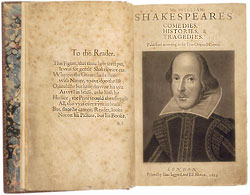
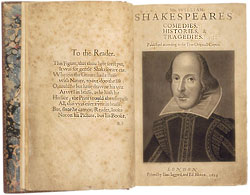
HEFTY AND FEATHERY at the same time, here's an airtight evidence of poetry's power to encapsulate anything of epic scope. One of my favorite poems from the anthology 180 More: Extraordinary Poems For Every Day (edited by Billy Collins), the following piece written by R.S Gwynn is simply nifty in summing up some of Shakespeare's masterpieces, whittling down the formidable canon to the level of a playful puzzle: a deconstructionist's romp through the ramparts of the Elizabethan verse structure that often looms like an enchanted jungle to many an English Lit major. Who says one can't graze through the wilderness of a poem, chew the cud of its subtleties, and lick one's lips with a flourish of a grin after reading? Consider this:

Shakespearean Sonnet

A father is haunted by his father’s ghost.
A boy and girl love while their families fight.
A Scottish king is murdered by his host.
Two couples get lost on a summer night.
A hunchback murders all who blocks his way.
A ruler’s rival plot against his life.
A fat man and a prince make rebels pay.
A noble Moor has doubts about his wife.
An English king decides to conquer France.
A duke learns that his best friend is a she.
A forest sets the scene for this romance.
An old man and his daughters disagree.
A Roman leader makes a big mistake.
A sexy queen is bitten by a snake.


Thursday, October 05, 2006

Raising My Bottles Of Beer To Mary Oliver

Got drunk recently, my head still reeling from the rhapsodies out of Mary Oliver's Blue Pastures, featuring 15 nourishing prose pieces "of nature, of writing, of herself and those around her." Winner of the Pulitzer Prize and the National Book Award, Mary Oliver regards this book as "biased, opinionated; also it is joyful, and probably there's despair here too..." I can only burp.


On being ruthless with one's commitment to creativity:

"It is six A.M., and I am working. I am absent-minded, reckless, heedless of social obligations, etc. It is as it must be. The tire goes flat, the tooth falls out, there will be a hundred meals without mustard. The poem gets written. I have wrestled with the angel and I'm stained with light and I have no shame. Neither do I have guilt. My responsibility is not to the ordinary, or the timely. It does not include mustard, or teeth. It does not extend to the last button, or the beans in the pot. My loyalty is to the inner vision, whenever and howsoever it may arrive. If I have a meeting with you at three o'clock, rejoice If I am late. Rejoice even more if I do not arrive at all.

There is no other way work of artistic worth can be done. And the occasional success, to the striver, is worth everything. The most regretful people on earth are those who felt the call to creative work, who felt their own creative power restive and uprising, and gave to it neither power nor time."


On being voracious for the world's feast of paradox:

"... I have found the headless bodies of rabbits and blue jays, and known it was the great horned owl that did them in, taking the head only, for the owl has an insatiable craving for the taste of brains... I know this bird. If it could, it would eat the whole world... The world where the owl is endlessly hungry and endlessly on the hunt is the world in which I live too. There is only one world."

On the identity of the chosen:

Who are you? They called out, at the edge of the village.
I am one of you, the poet called back.
Though he was dressed like the wind, though he looked like
a waterfall

On the prerequisites of becoming a poem:

"The translation of experience into contemplation, and the placement of this contemplation within the formality of a certain kind of language, with no intent to make contact-- be it across whatever thin or wild a thread--with the spiritual condition of the reader, is not poetry. Archibald MacLeish: Here is the writer, and over there--there is "the mystery of the universe." The poem exists--indeed, gets itself written--in relation between the man and the world. The three ingredients of poetry: the mystery of the universe, spiritual curiosity, the energy of language."


On the in/significance of poetry:

"Now, of course, in the hives and dungeons of our cities, poetry cannot console, it carries no weight, for the pact between the natural world and the individual has been broken. There is no more working for harvest--only hunting, for profit. Lives are no longer exercises in pleasure and valor, but only the means to the amassment of worldy goods. If poetry is ever to become meaningful to such persons, they must take the first step-- away from the materially bound and self-interested lives, toward the trees, and the waterfall. It is not poetry's fault that it has so small and audience, so little effect upon the frightened, money-loving world. Poetry, after all, is not a miracle. It is an effort to formalize (ritualize) individual moments and the transcending effects of these moments into a music that all can use. It is the song of our species."

Monday, June 26, 2006

From Rapture To Rupture

If you've got the temerity for a tightrope pirouette and the gall to imagine yourself a contender for the reality show Fear Factor, it wouldn’t be too farfetched to see a camel entering the eye of the needle. Or, the hole of a wedding ring.

Long before Sun.Star Cebu sent shivers down the spines of singletons with its recent three-part series called “Going Solo” — proving there’s an epidemic of unhappiness in the city enough to make annulment lawyers grinning their way to the banks— a whole galaxy of words has coalesced into a common fact: Marriage is a matter of courage.

Forget the flair of the wedding planner who, having read too much romance novels or seen her immodest share of Hollywood potboilers, will have the prospective couple believe that everything in the glossy magazine or in her favorite teleserye is true. Ah, the mirage of two minds admitting no impediment to the pleasure principle in this era of advertising.

Truth be told, no wedding planner takes care about what happens next because it’s really up to the couple concerned to make a sense of rhythm and order, a cosmos out of the chaos theory so true to the frowns of feminists and the caution of the commitment-phobic.

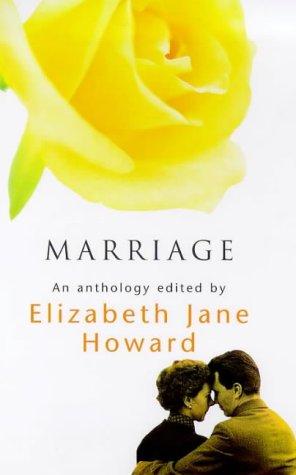
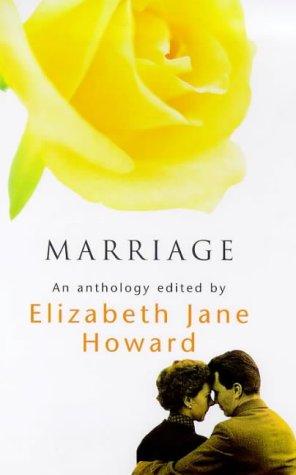
“It is the most challenging relationship any of us attempt in our lives, and an increasing number of us seem to fail,” goes the blurb of Elizabeth John Howard’s book Marriage, titled simply thus as if to leave no room for further complications. It’s one of the gifts my wife and I received when we agreed to go headlong into our common adventure against the unknown four years ago.

It’s a jungle out there after the wedding photographer finds another client for a funeral, probably of someone who succumbed to the sweet hereafter in the wake of sleeping with snakes or swimming together with piranhas. Or so agree with a cuss “practically one couple every 24 hours” who kick themselves to Splitsville, as cited in the special report.

When one writer defined courage as a “conquest of fear,” he might as well have described marriage as a mind-over-matter engagement with reality at the risk of losing one’s head. Or, against the slings and arrows of domestic fortune, ducking under the matrimonial bed. If you don’t have the mind—or the moxie— for it, you could tear out your hair about psychological incapacity, like 95 per cent of the petitioner for annulments in the city.

From someone who came short of murdering her husband, erasing him from her existence the legal way out, it struck me that my friend C. still has the grace to wax hopeful for me and my wife, writing a dedication on the book’s flyleaf: “All the best.” Not for better or for worse, mind you. Something that I wished for her, too, when she opted not let the failure of her first marriage be a closure for finding and fulfilling herself.

Cautionary tales about lovebirds turning targets for slingshots, she got a first-hand account. But that hasn’t stopped her from daring to take a second chance. Hopefully this time, her second husband is someone she could hum an ode with against all odds. And, in the process of partaking the gifts of their individuality, may they become sentinels of each other’s solitude.

To rage is fine, true. But nothing beats the basic or the residual verities of clichĆ©s: Faith, hope, love. That, plus the creative spunk and, yes, the courage to chuckle against one’s cynical heart.

In closing, here’s a bit from Howard’s book that singletons might consider for a second look. “There is no greater risk, perhaps than matrimony,” averred Benjamin Disraeli, from a letter to a lady on her engagement. “But there is nothing happier than a happy marriage.”

__________________________________________________________________

Howard's anthology is a treasure trove of extracts from novels, short stories, poems-- all illustrating the changing moods of marriage, from joy to despair. Her choices are eclectic and refreshingly unexpected, ranging from Anton Chekov, C.S. Lewis, Jane Austen, Michel de Montaigne, Erich Maria Remarque, Robert Graves, Oscar Wilde, Franz Kafka, Thomas Hardy, Virginia Woolf, Gustave Flaubert, William Shakespeare, James Thurber, Evelyn Waugh, George Eliot, George Bernard Shaw, Benjamin Disraeli, etc.

Tuesday, March 28, 2006

Once Upon a Book Launching


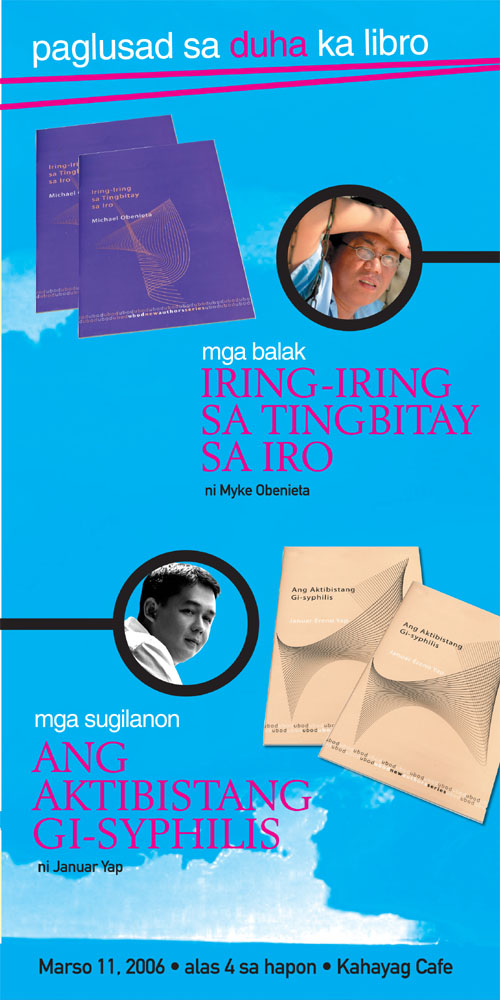
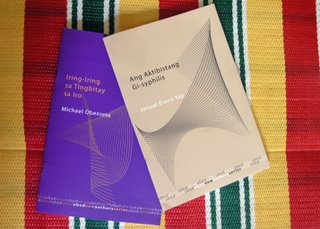
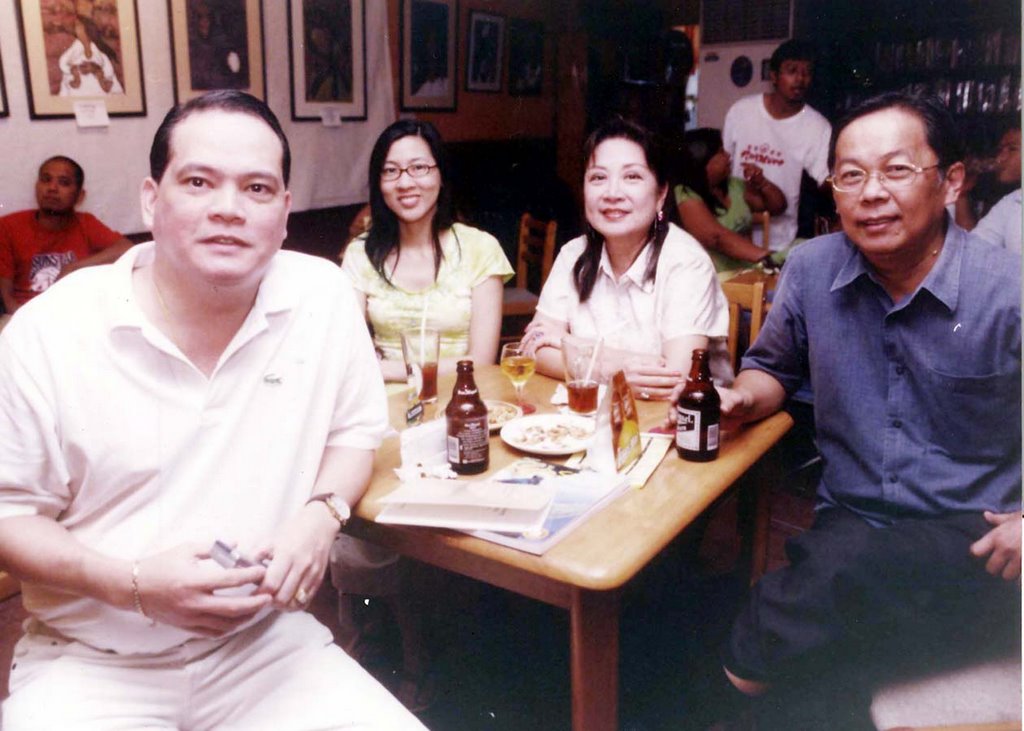
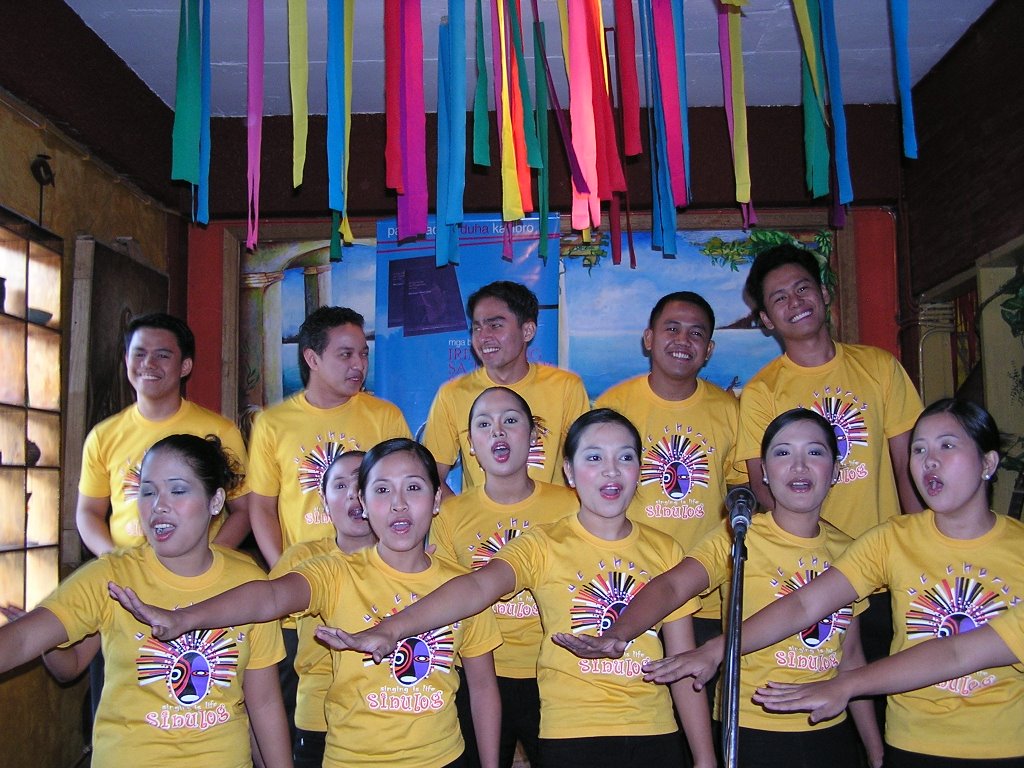
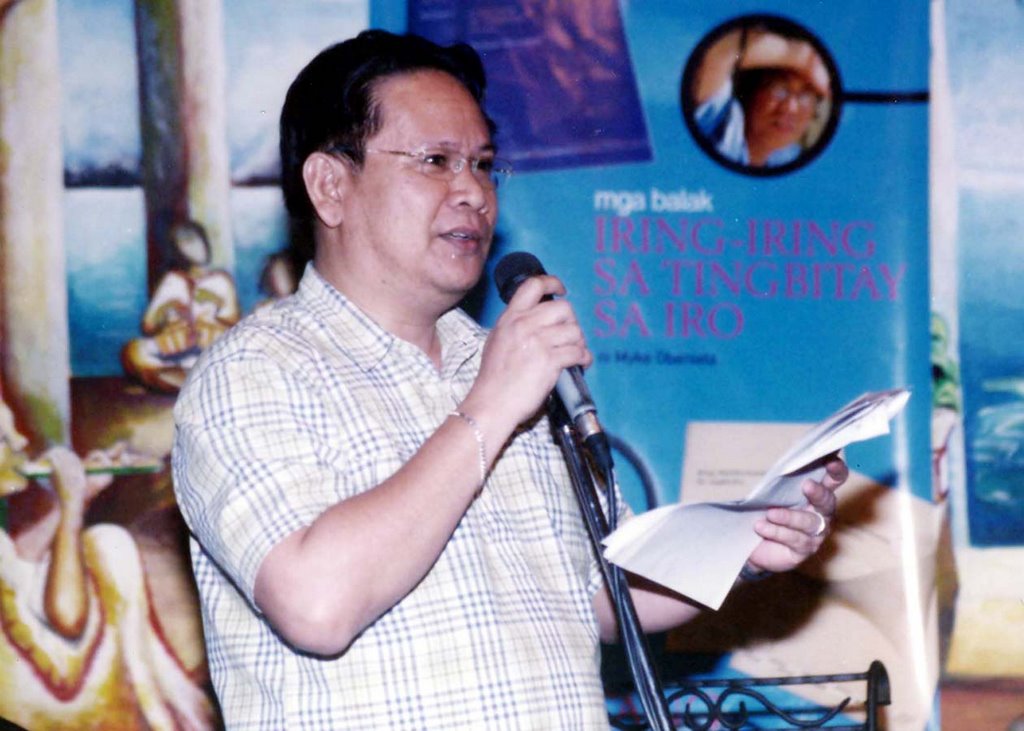
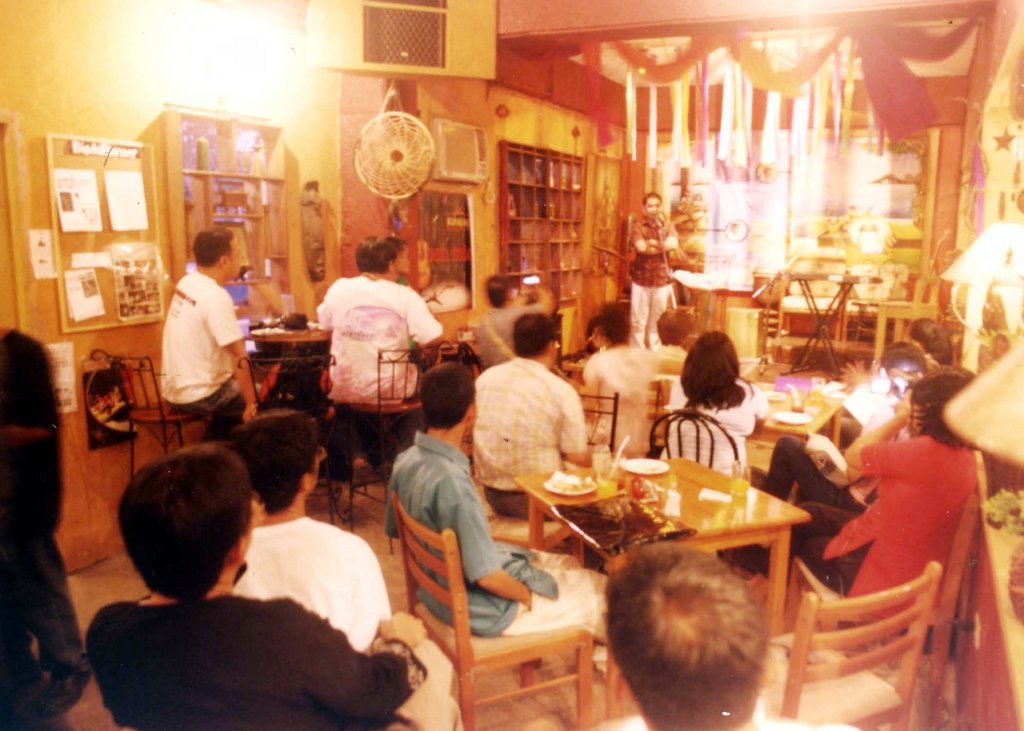
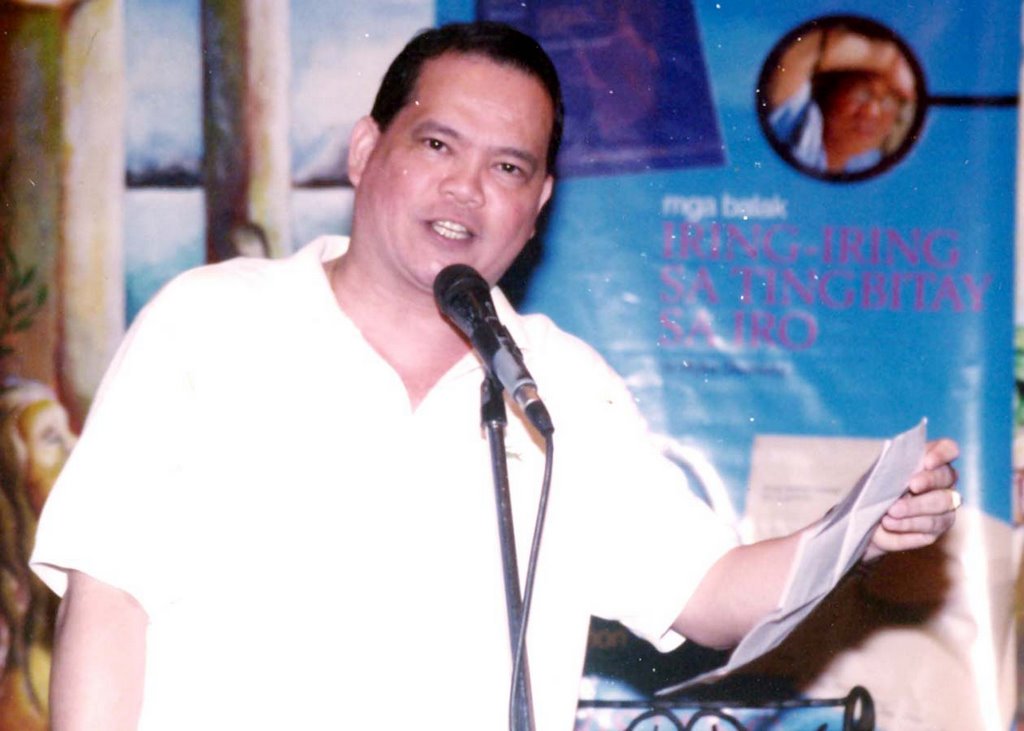
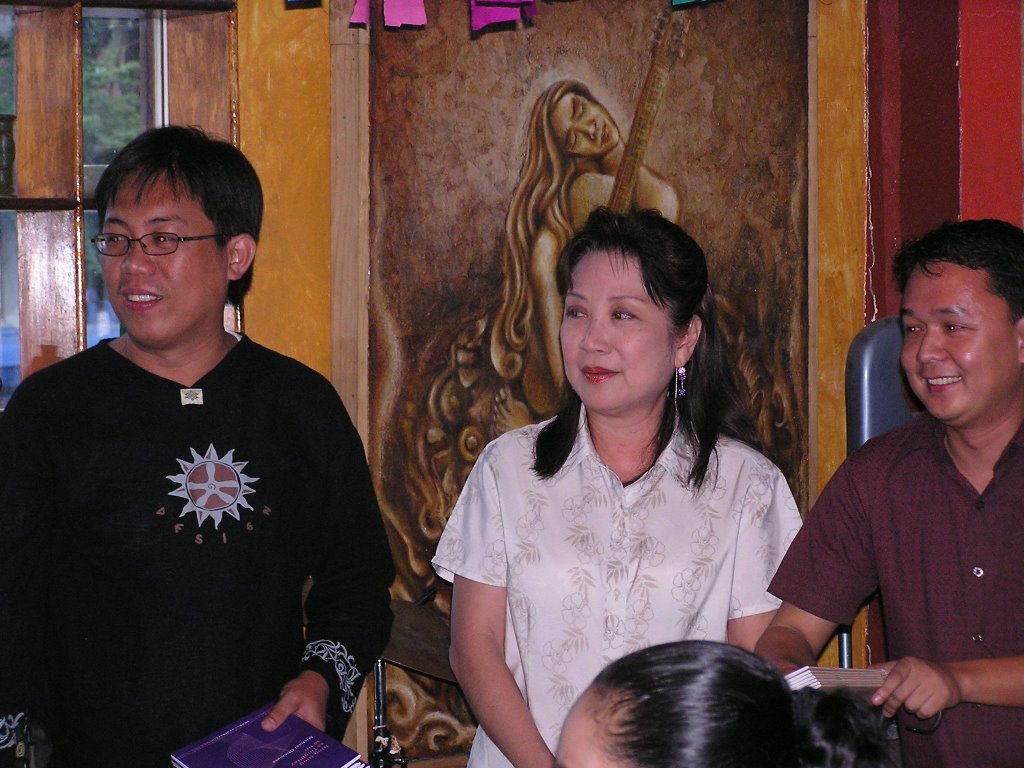
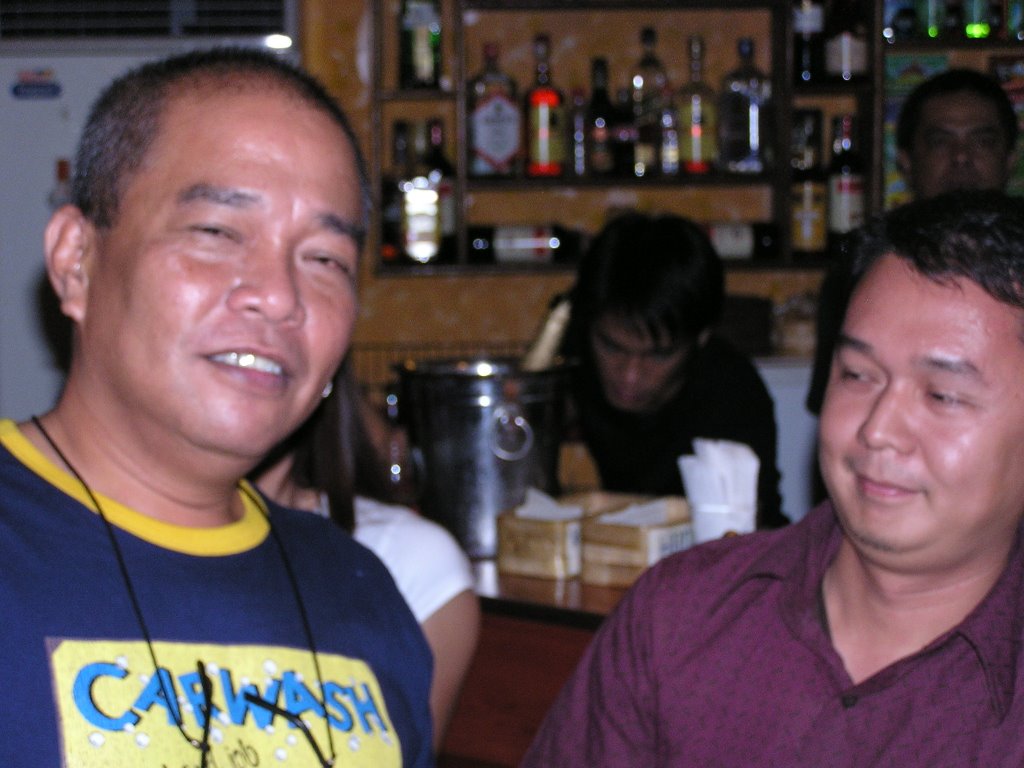
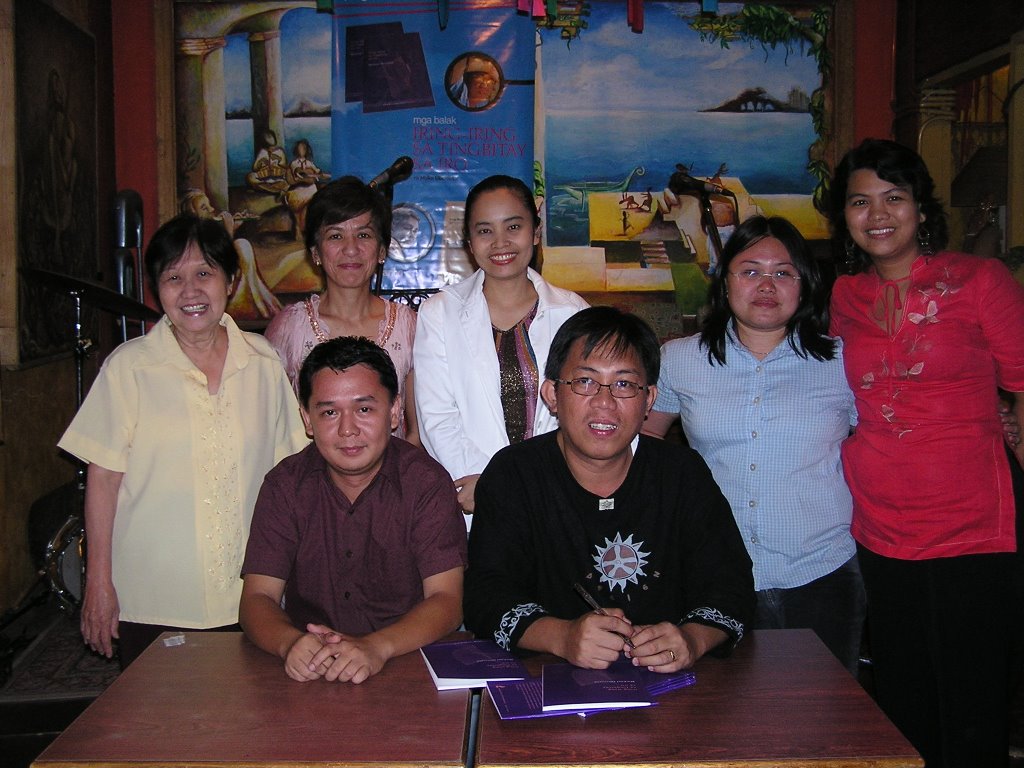
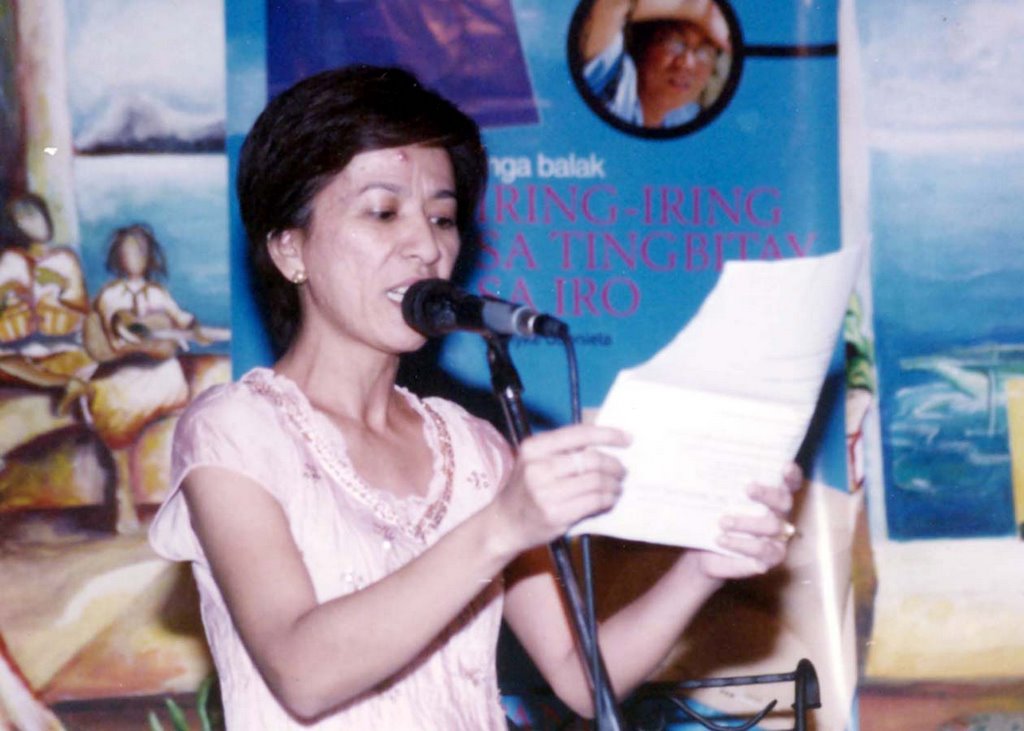
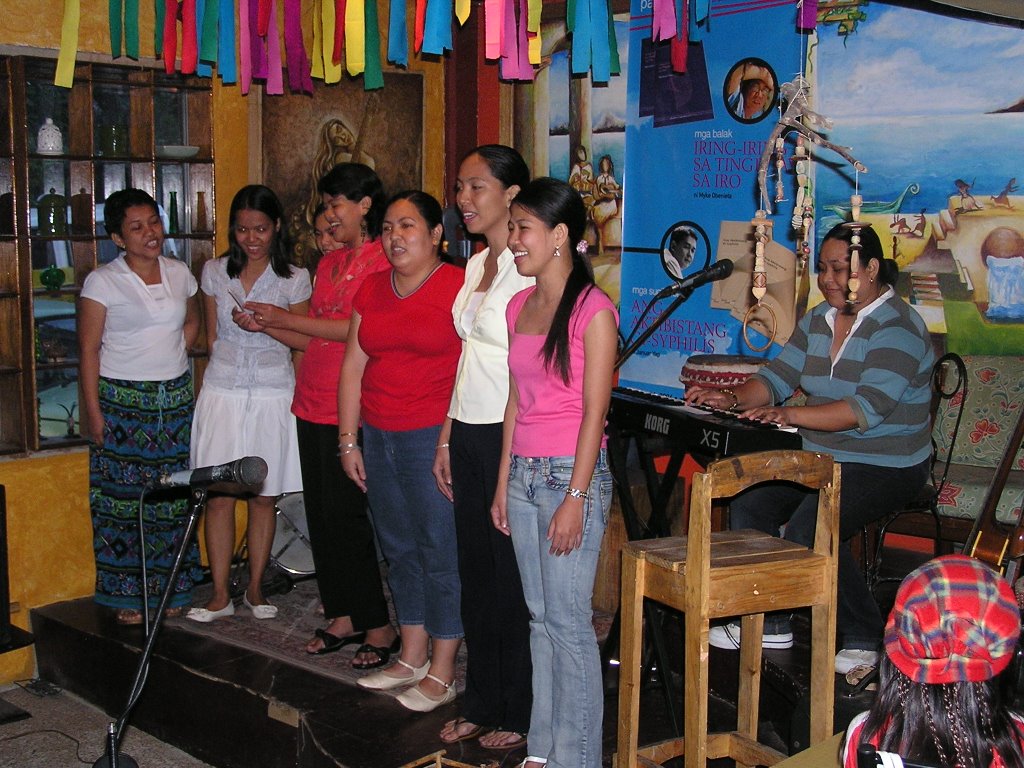
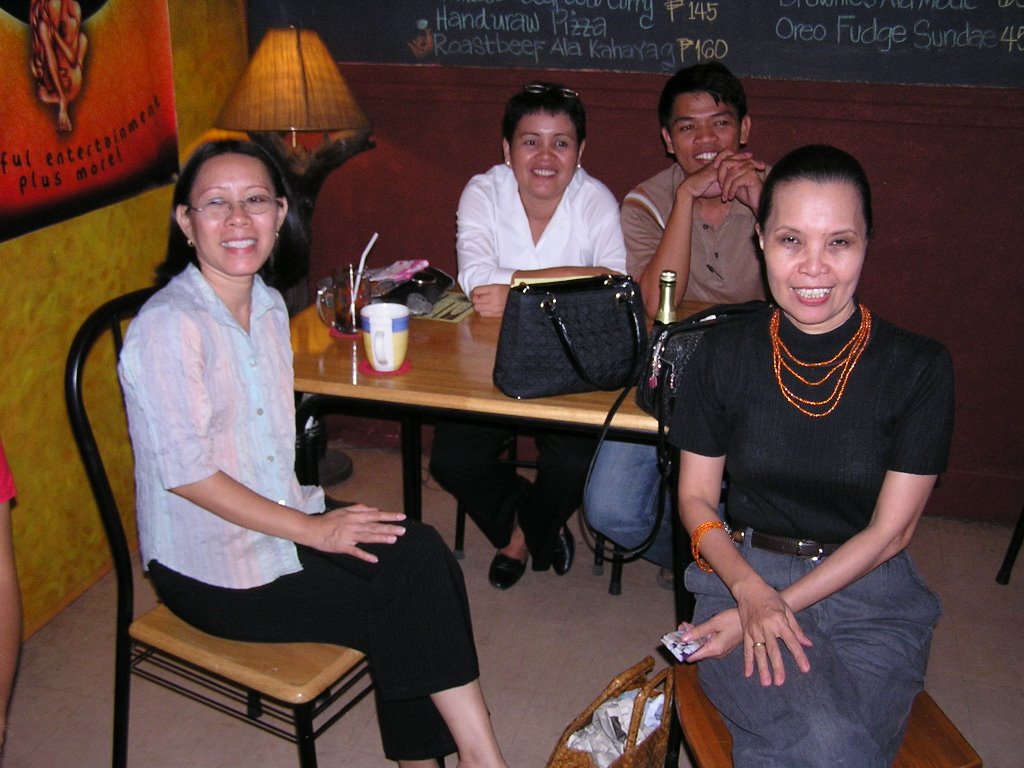
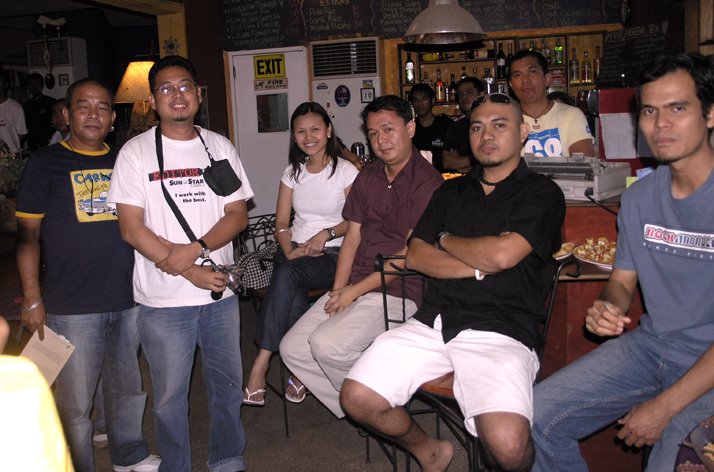
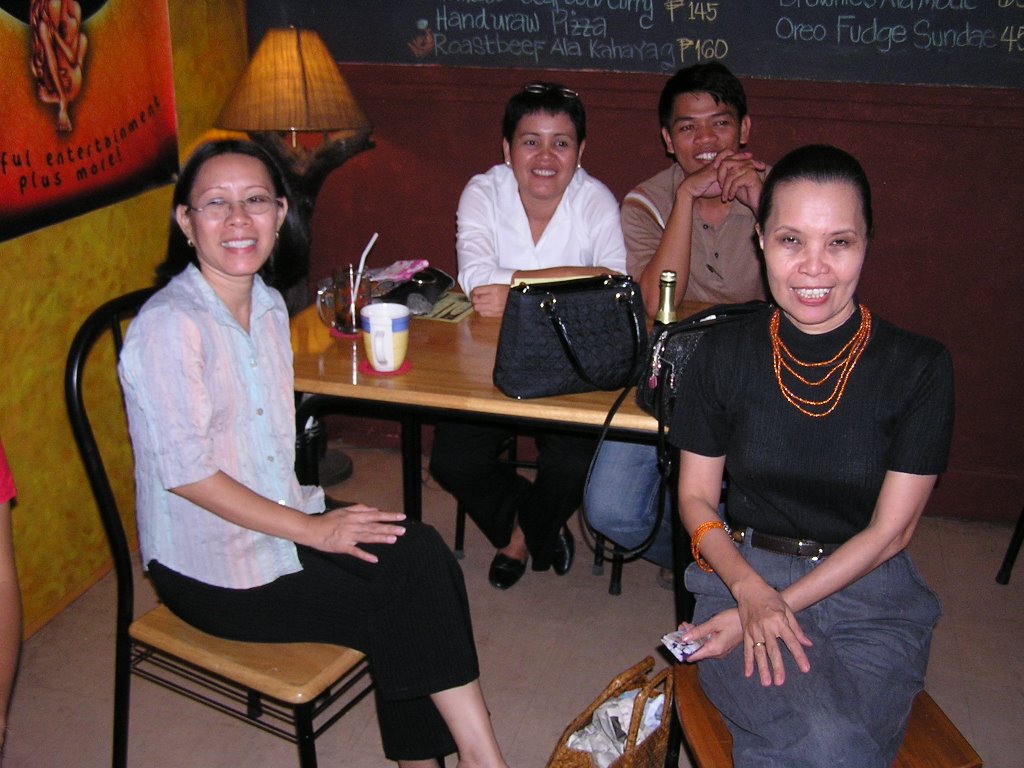
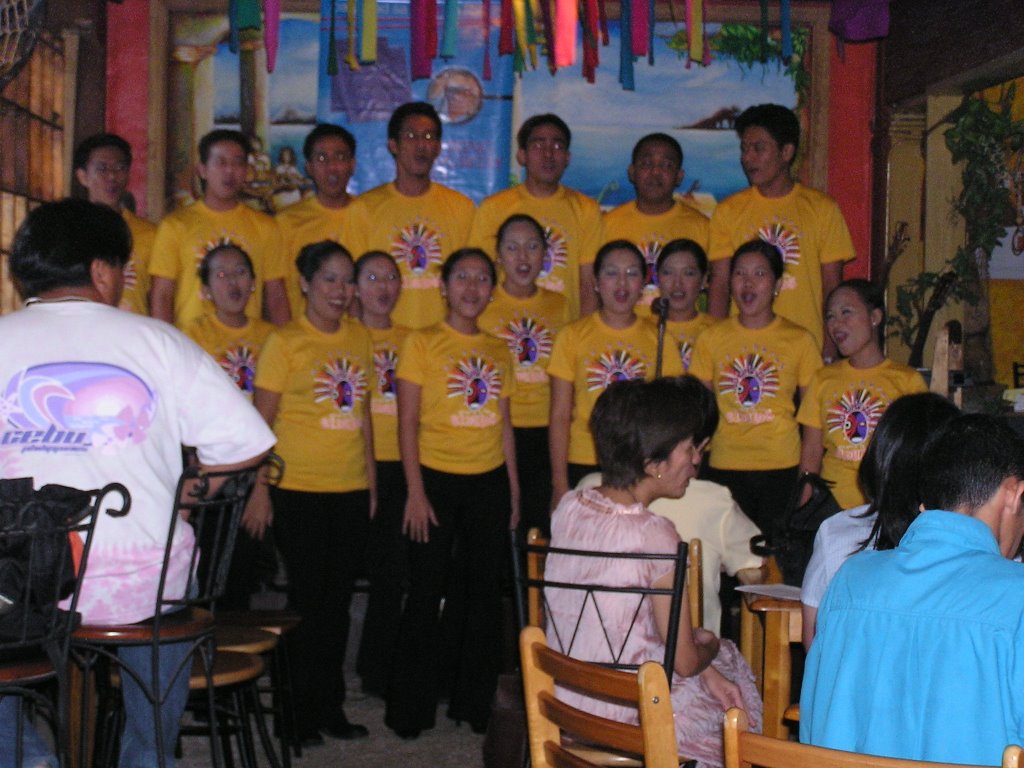
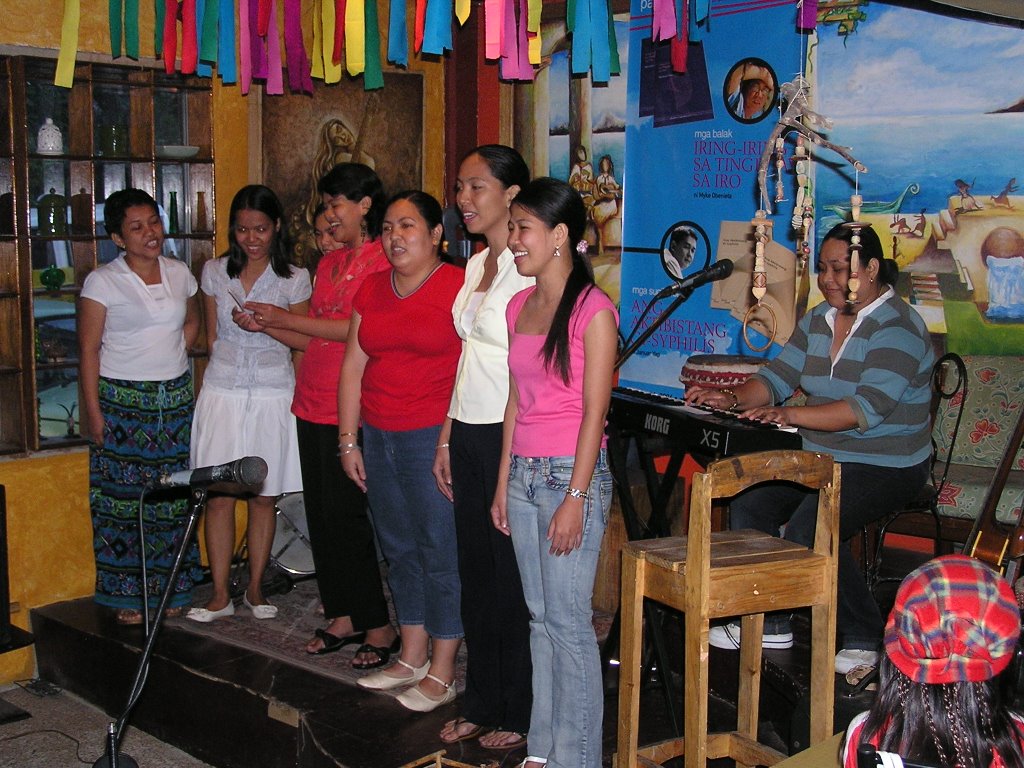
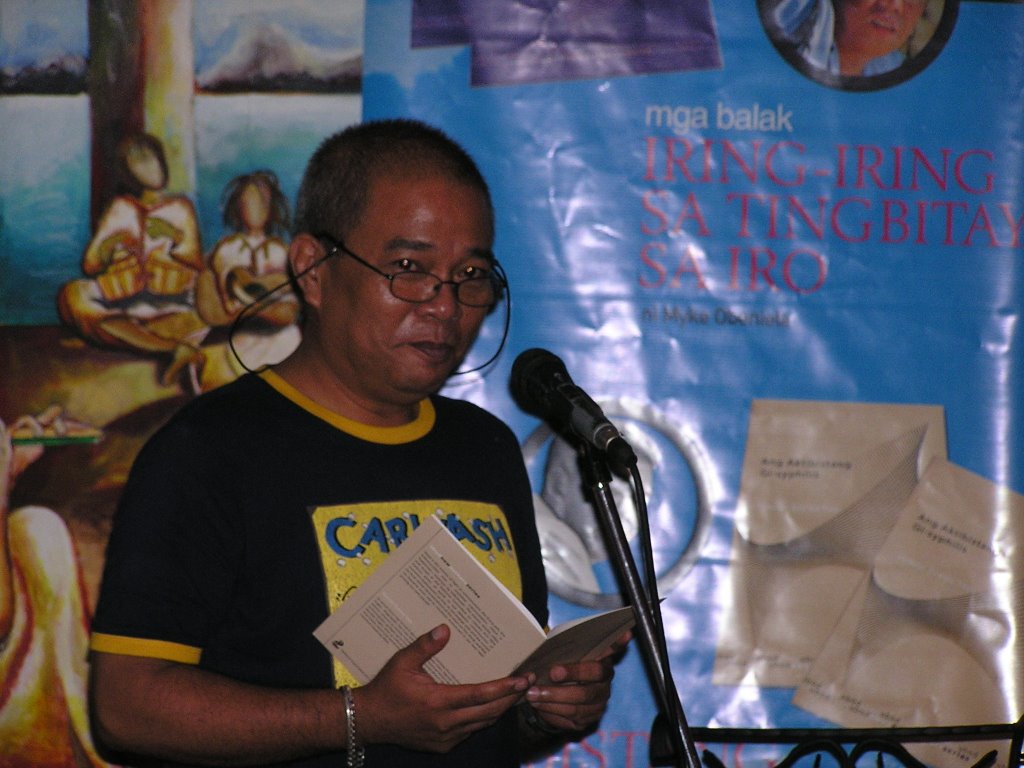
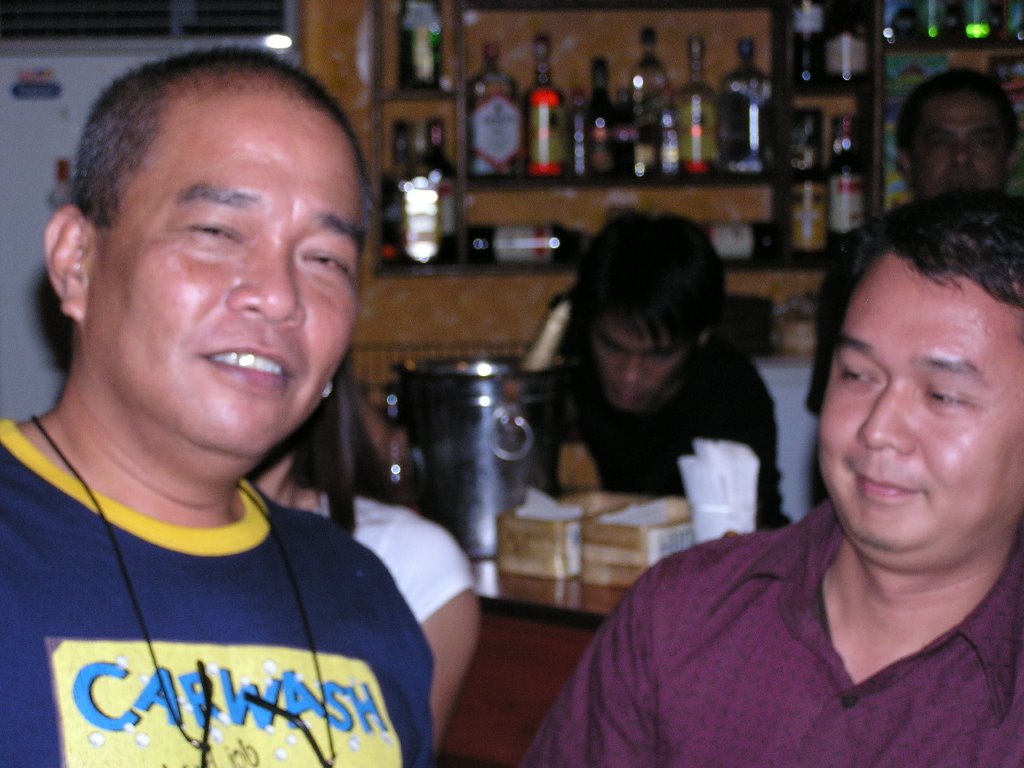
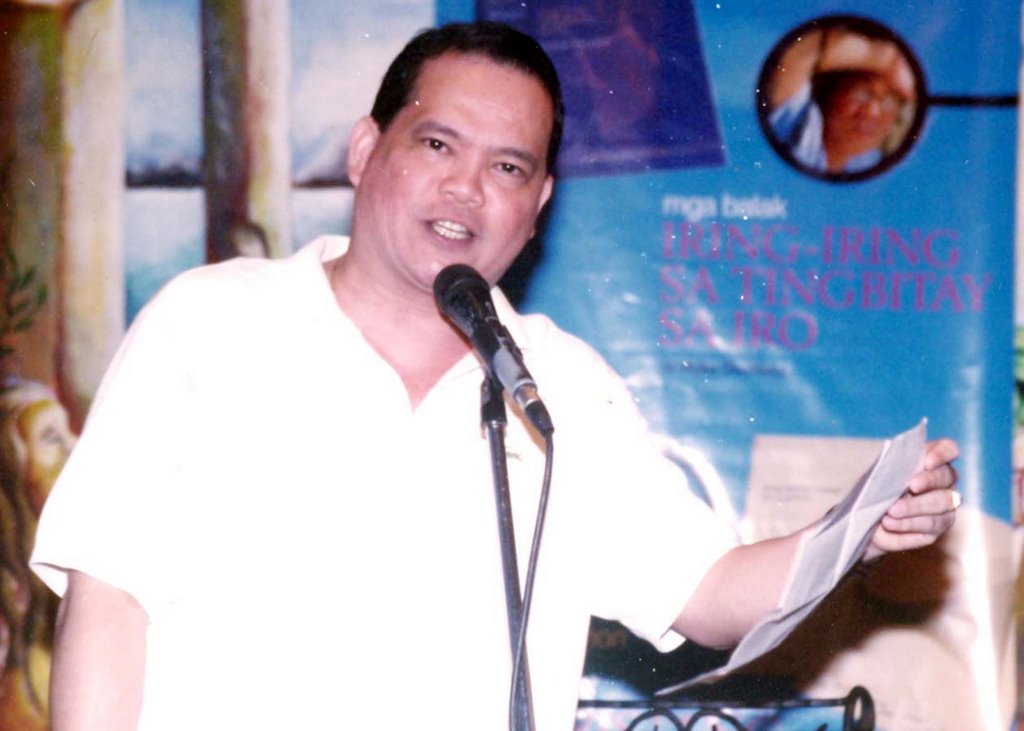
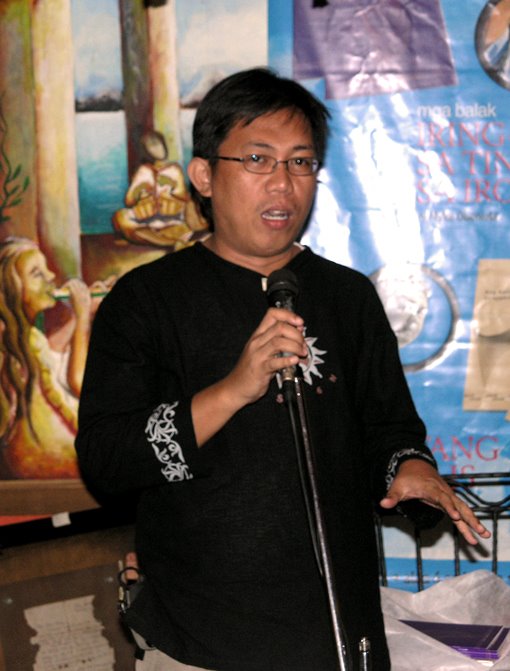
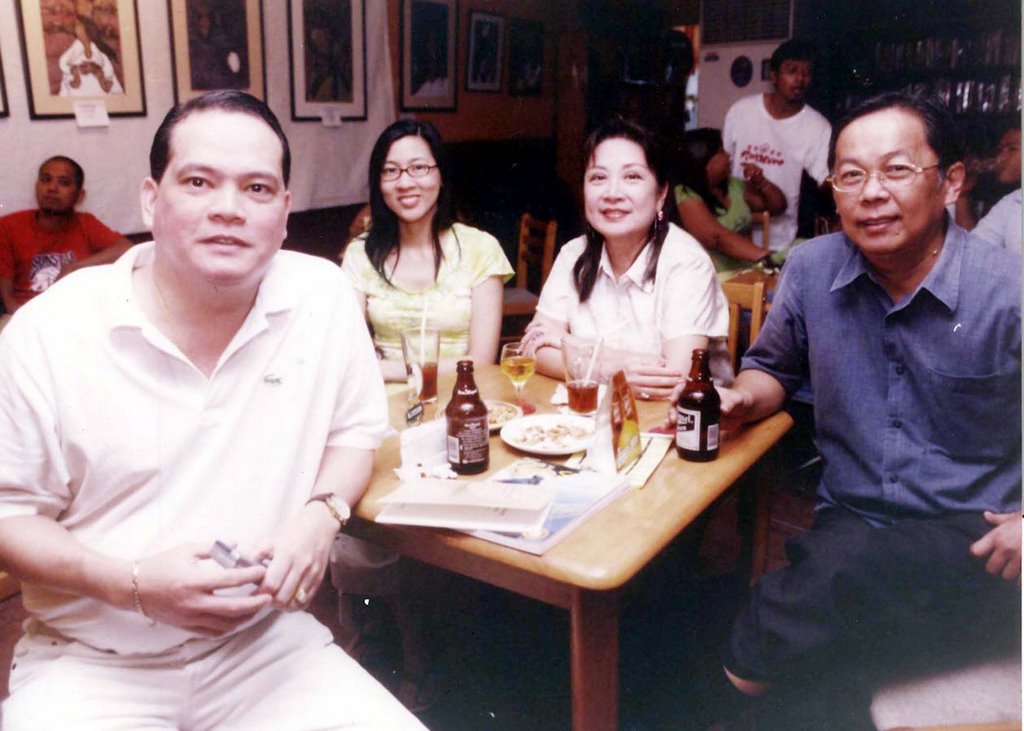
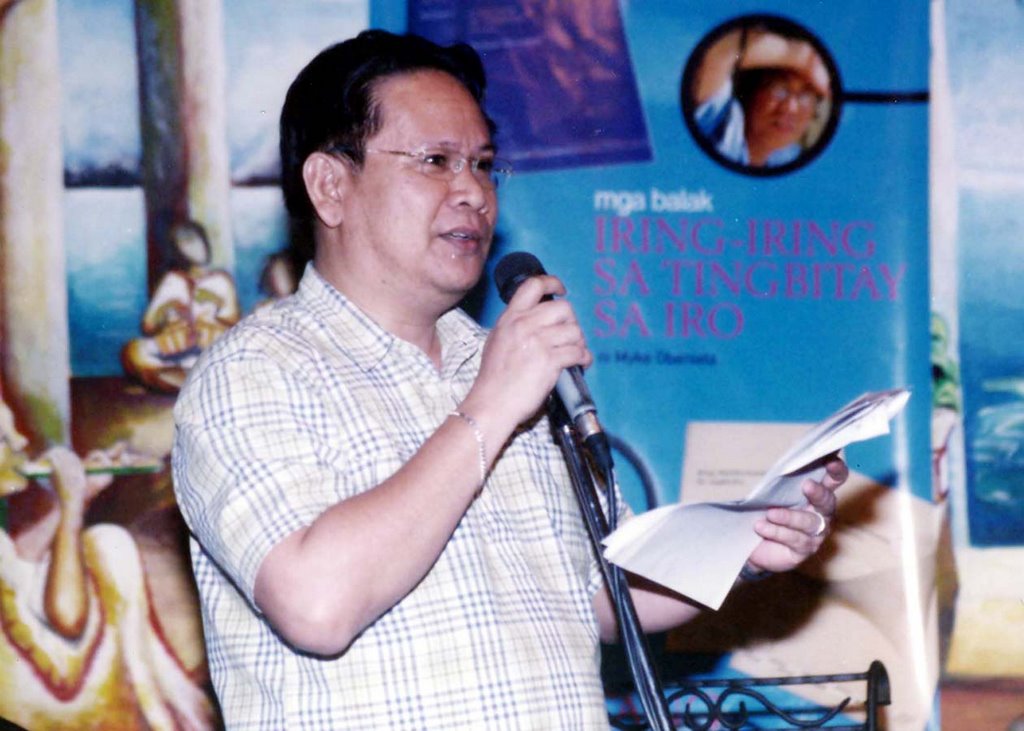
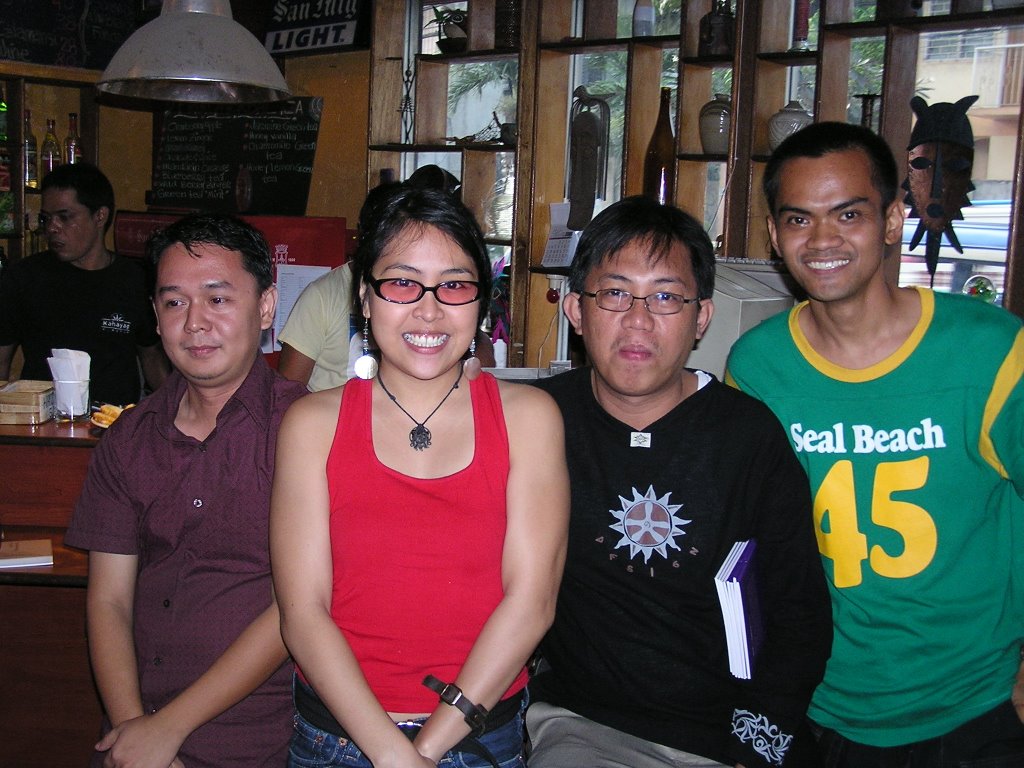
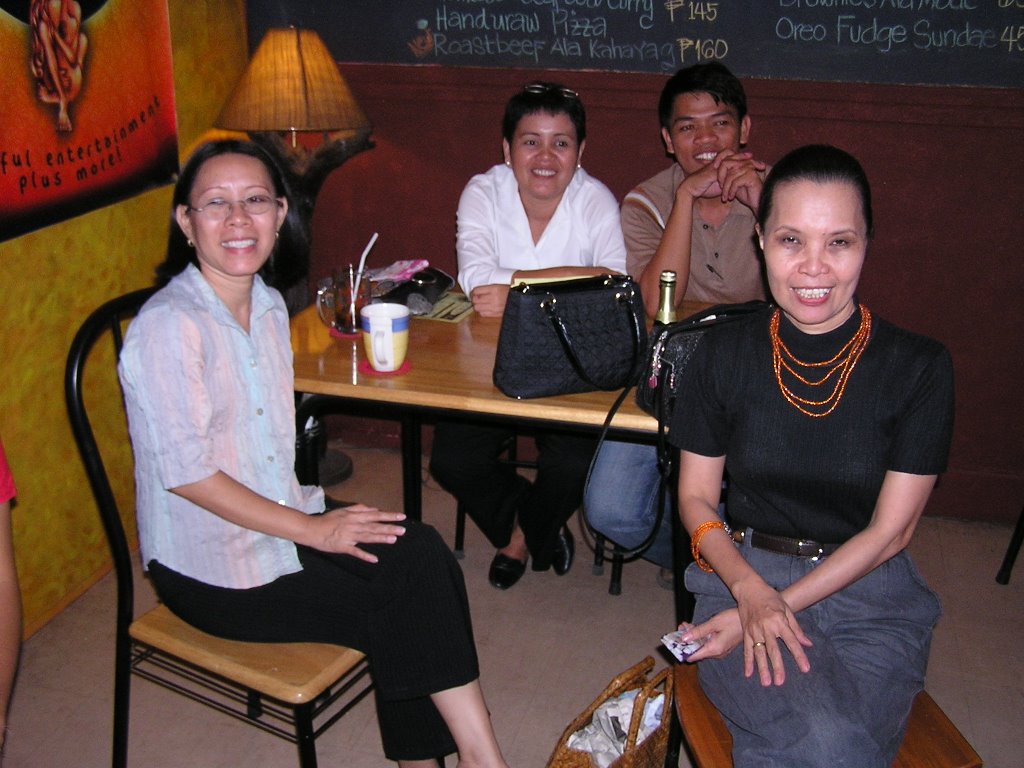
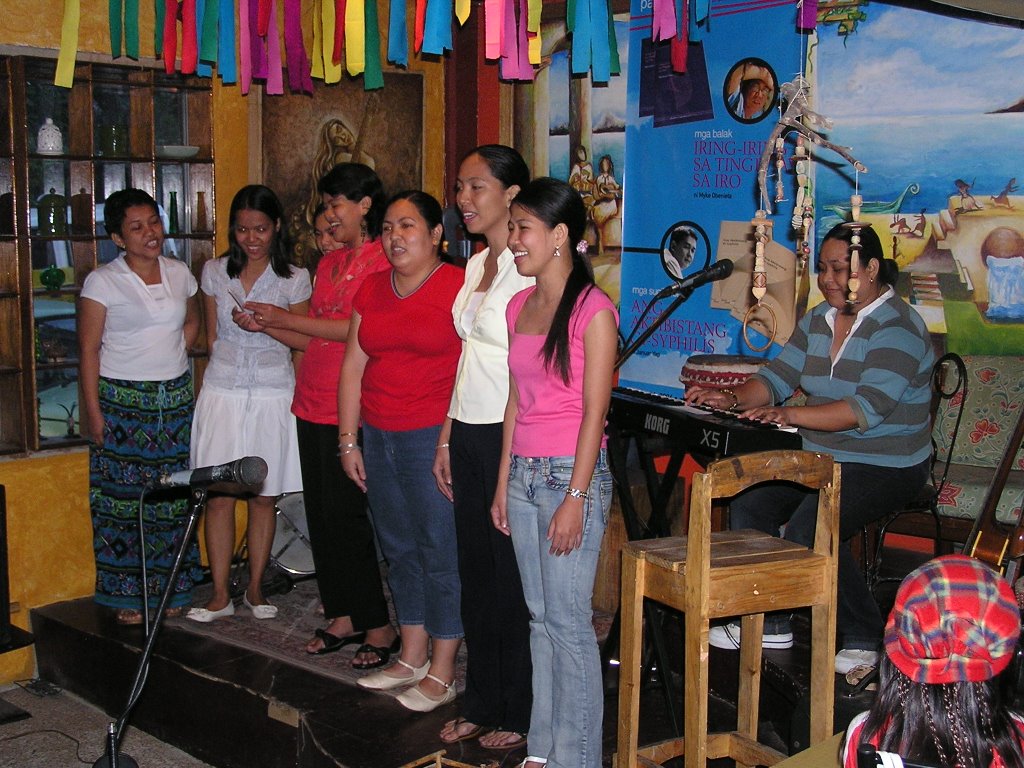
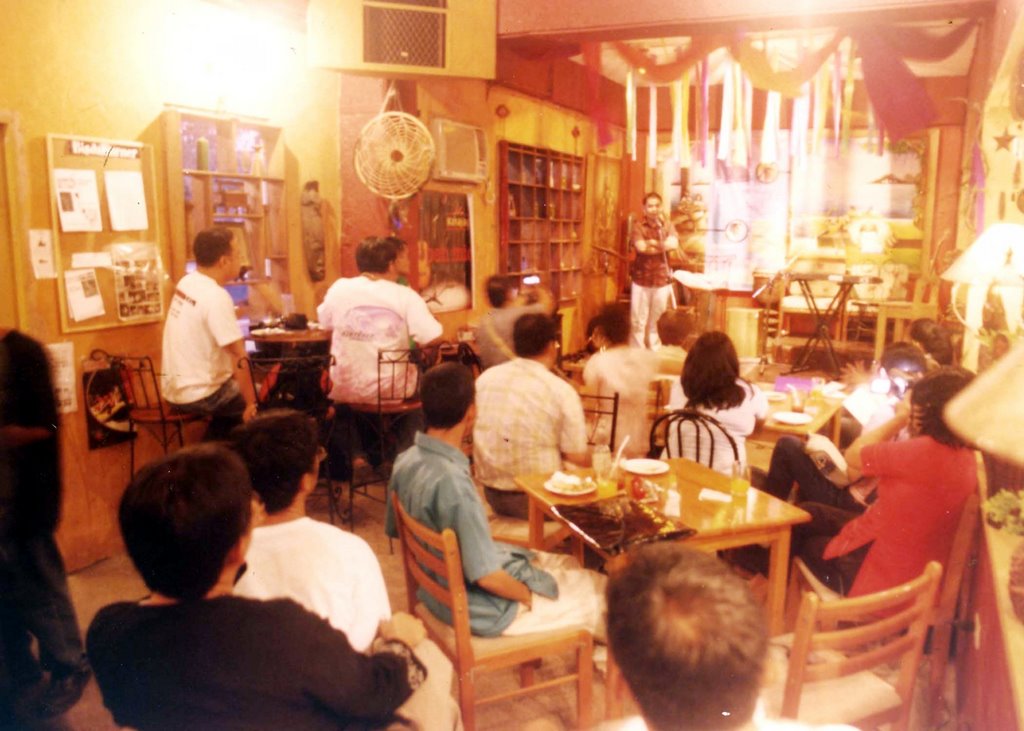
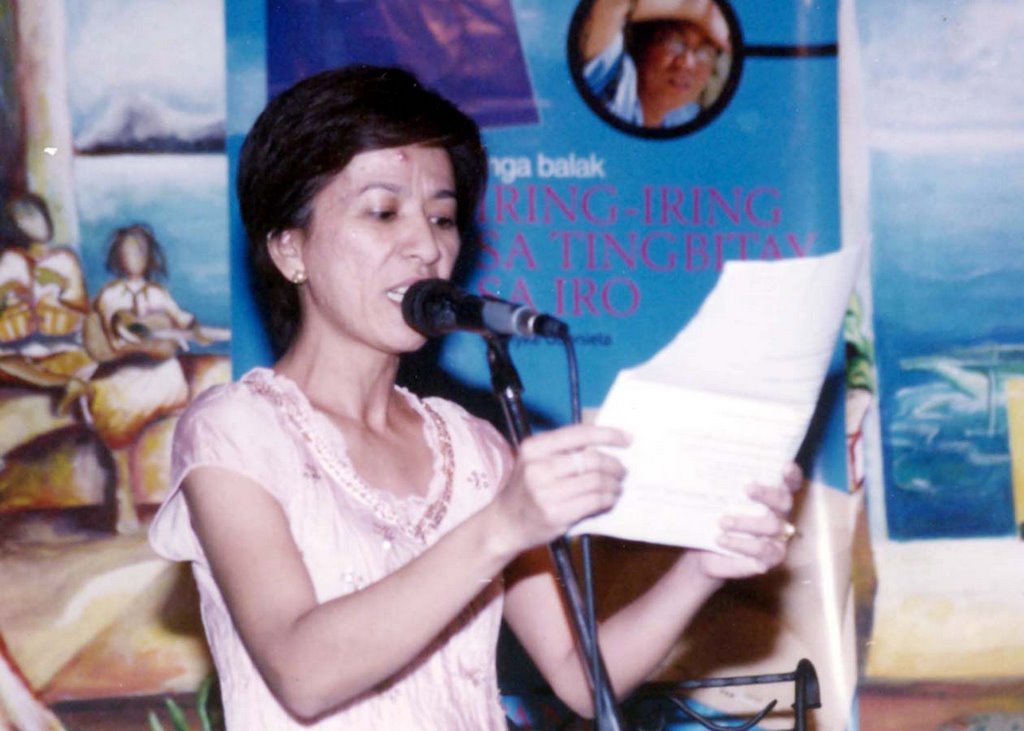
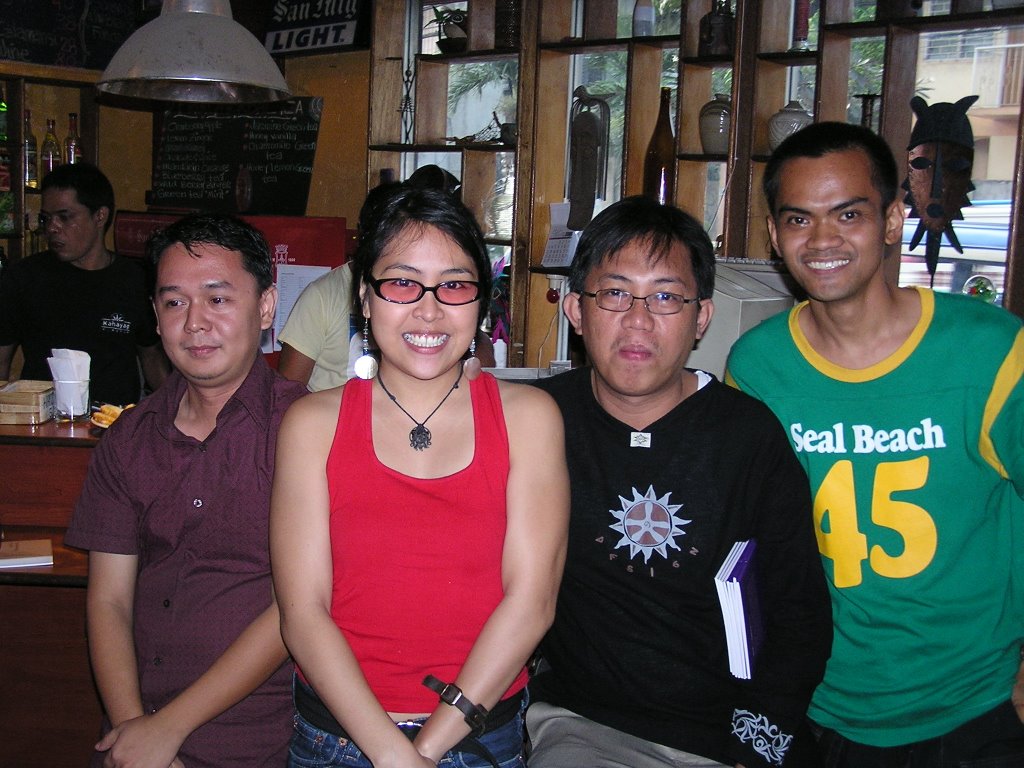
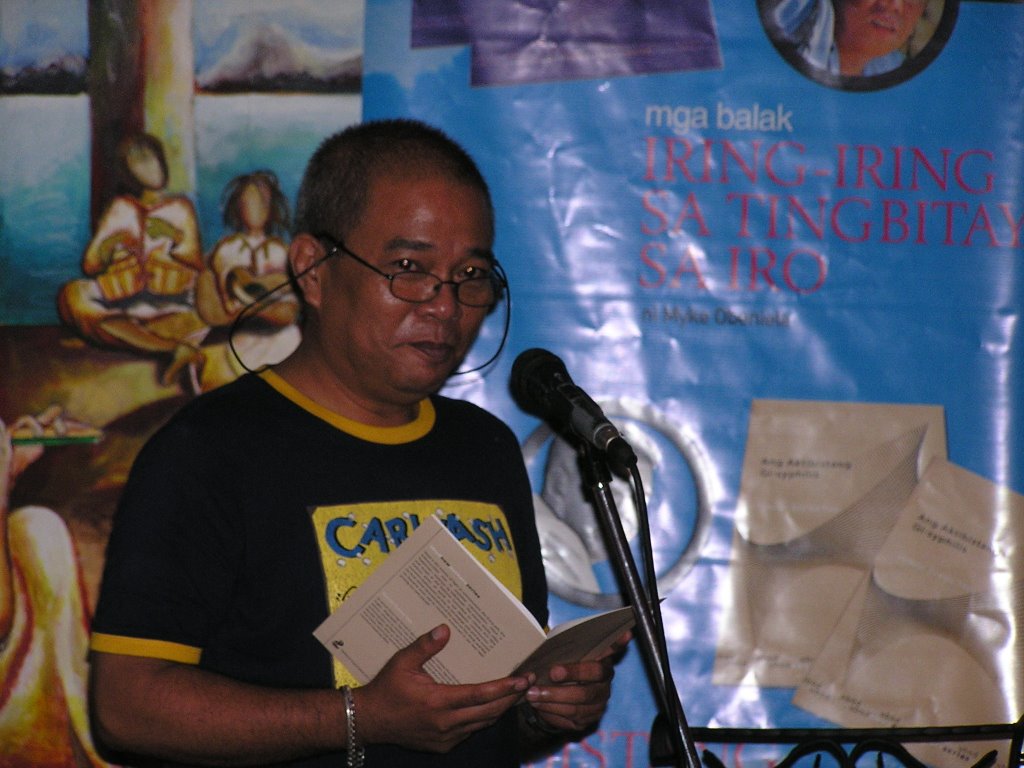
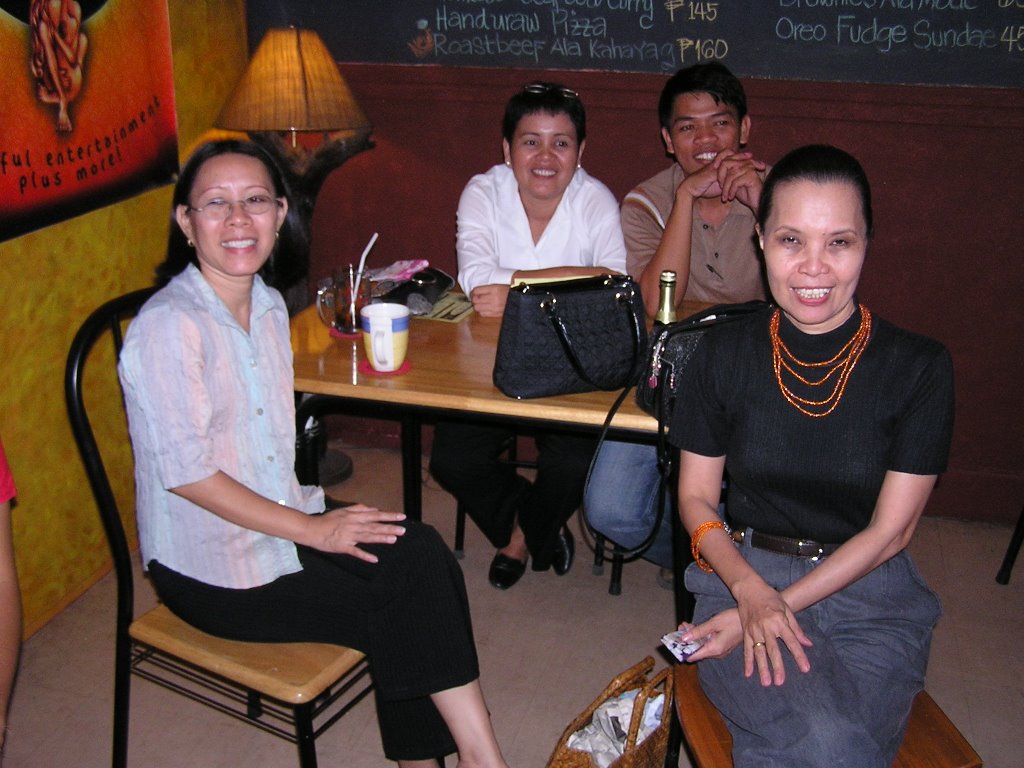
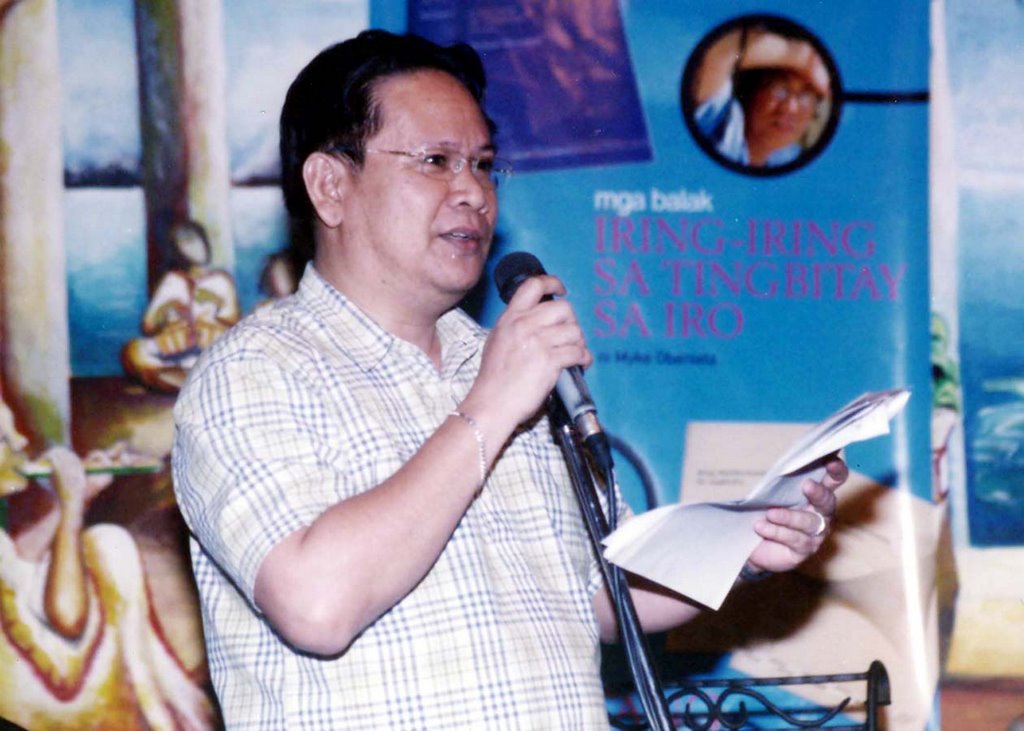
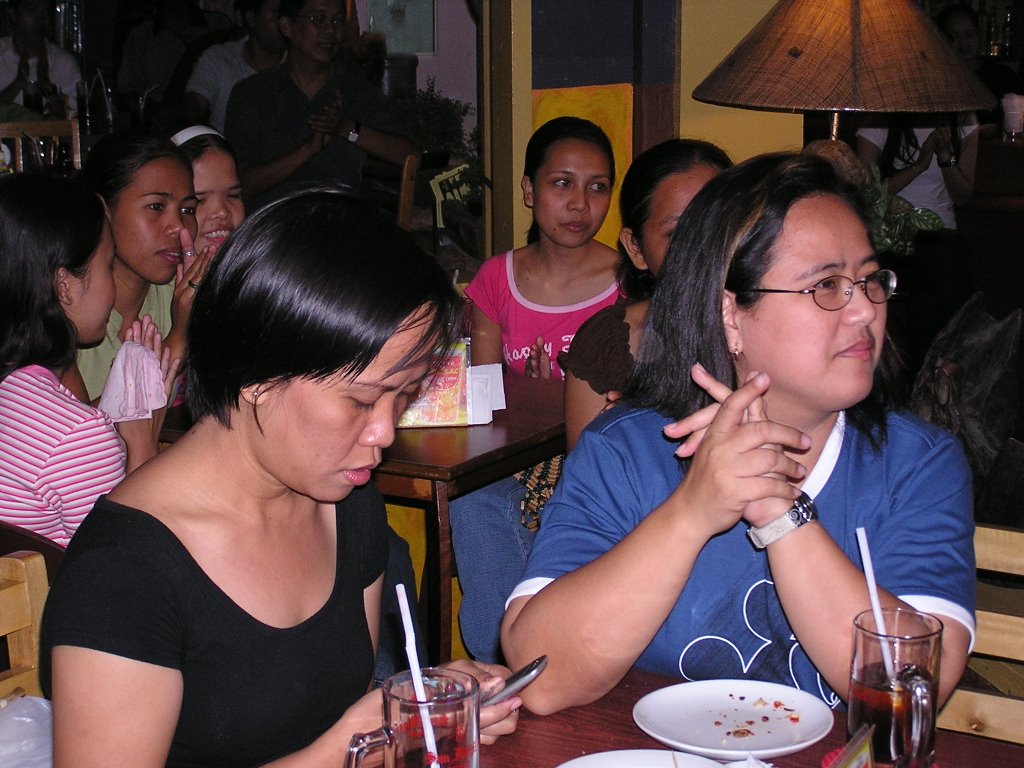
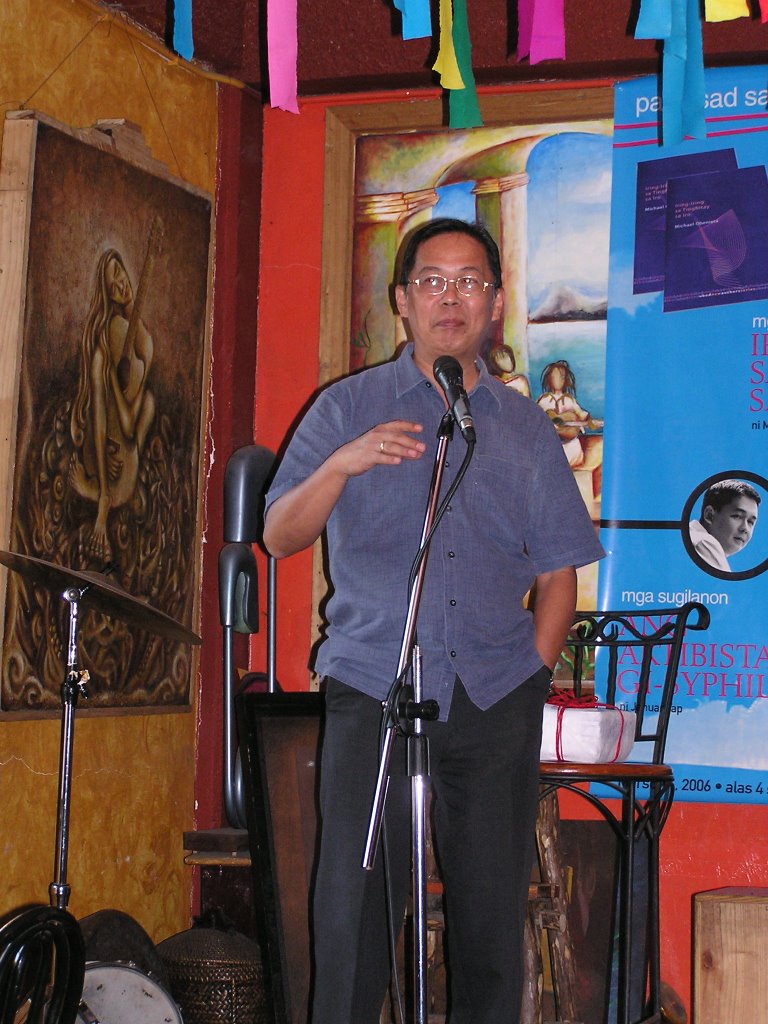
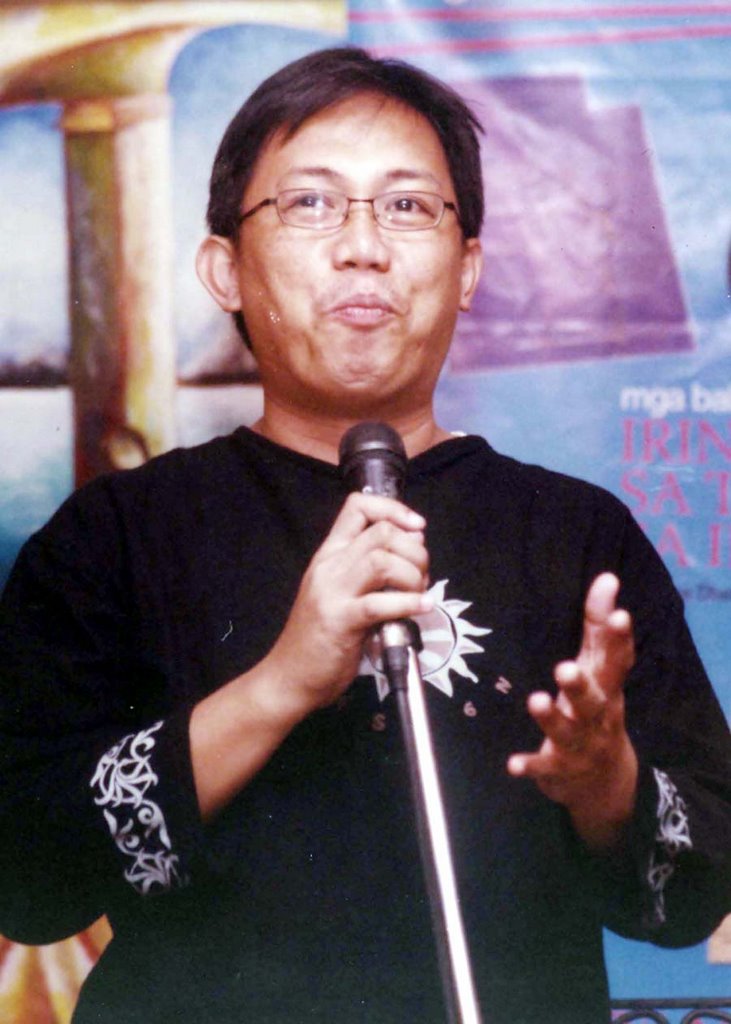
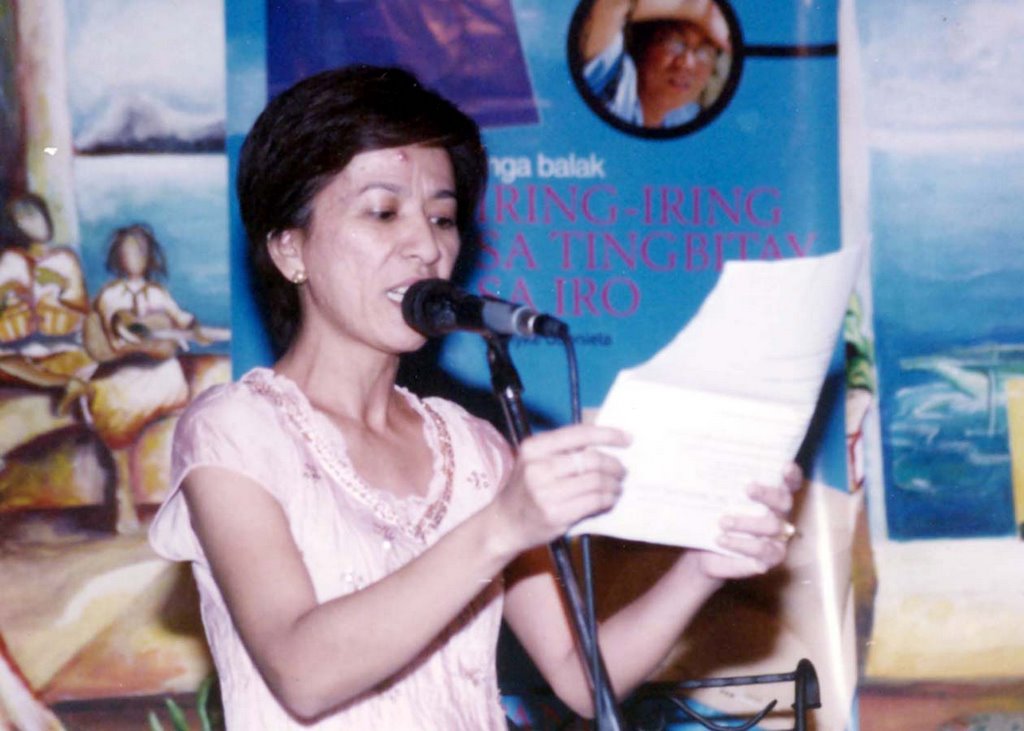
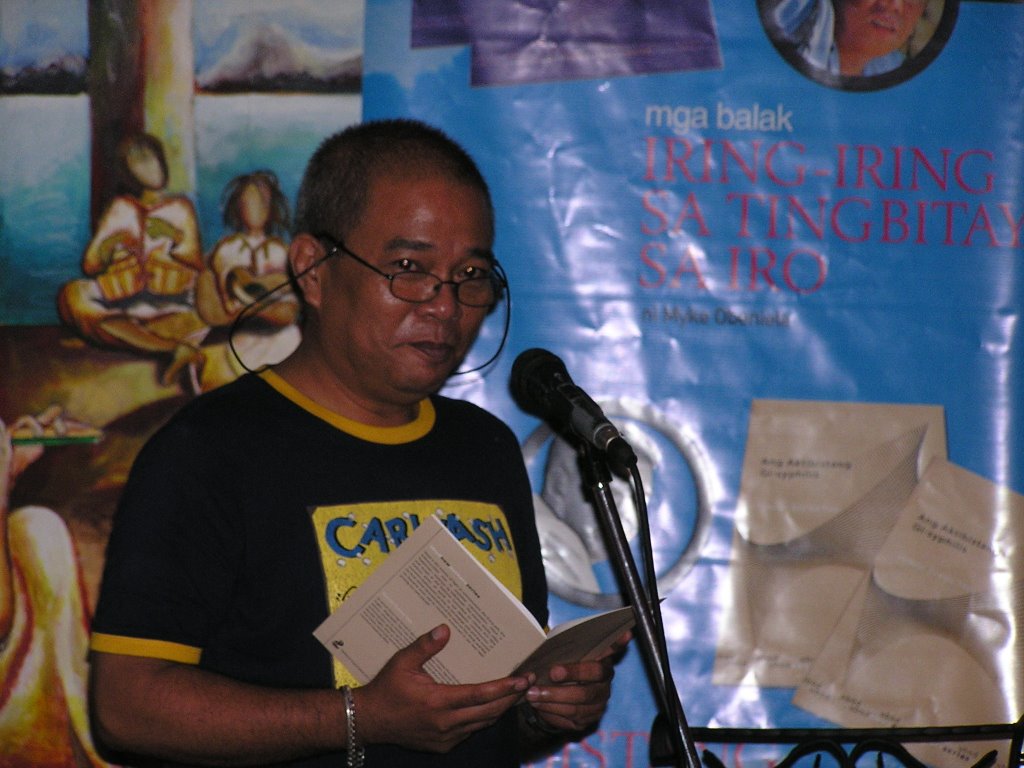
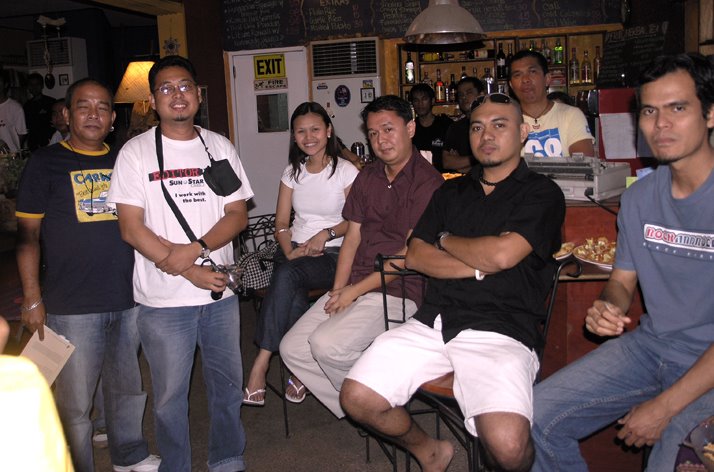
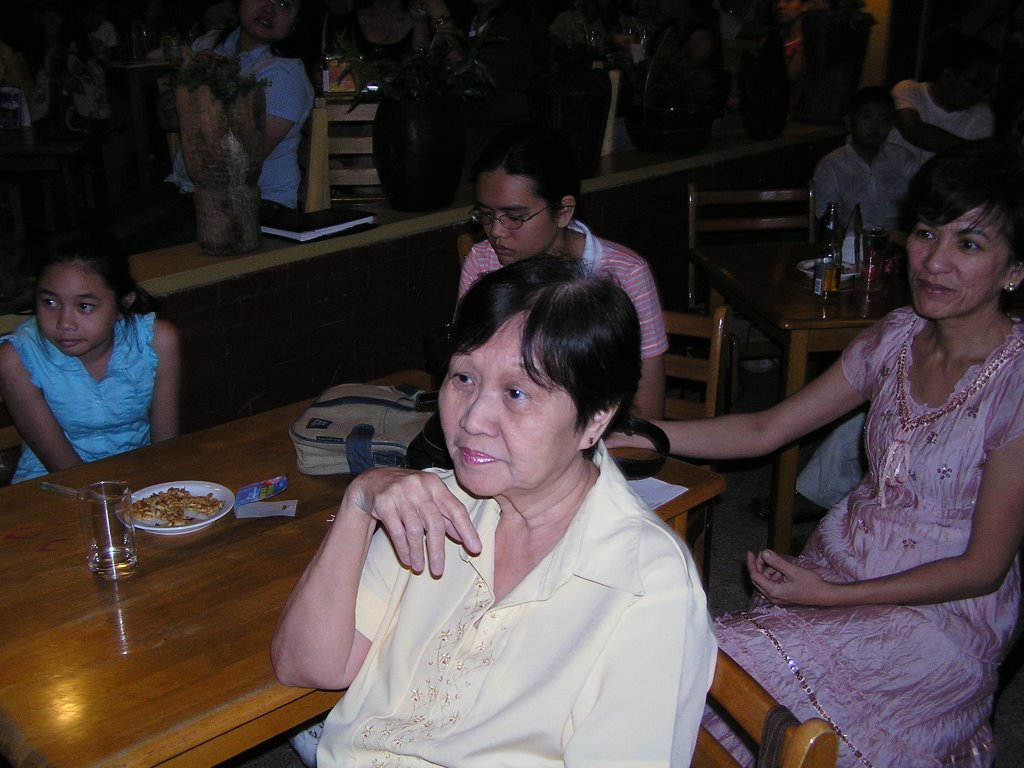
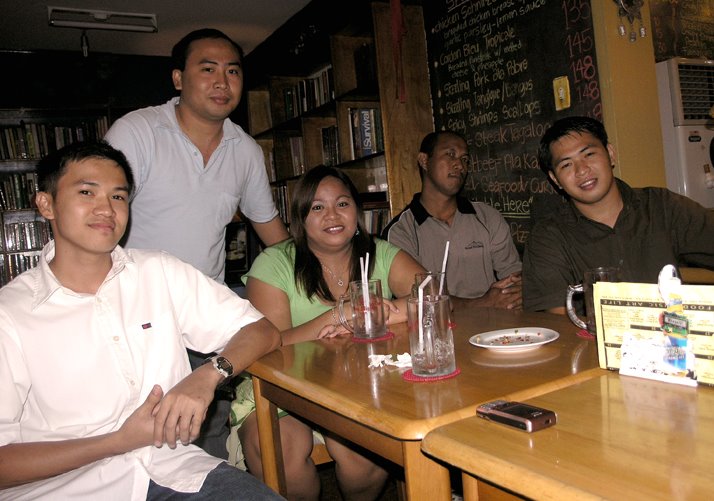
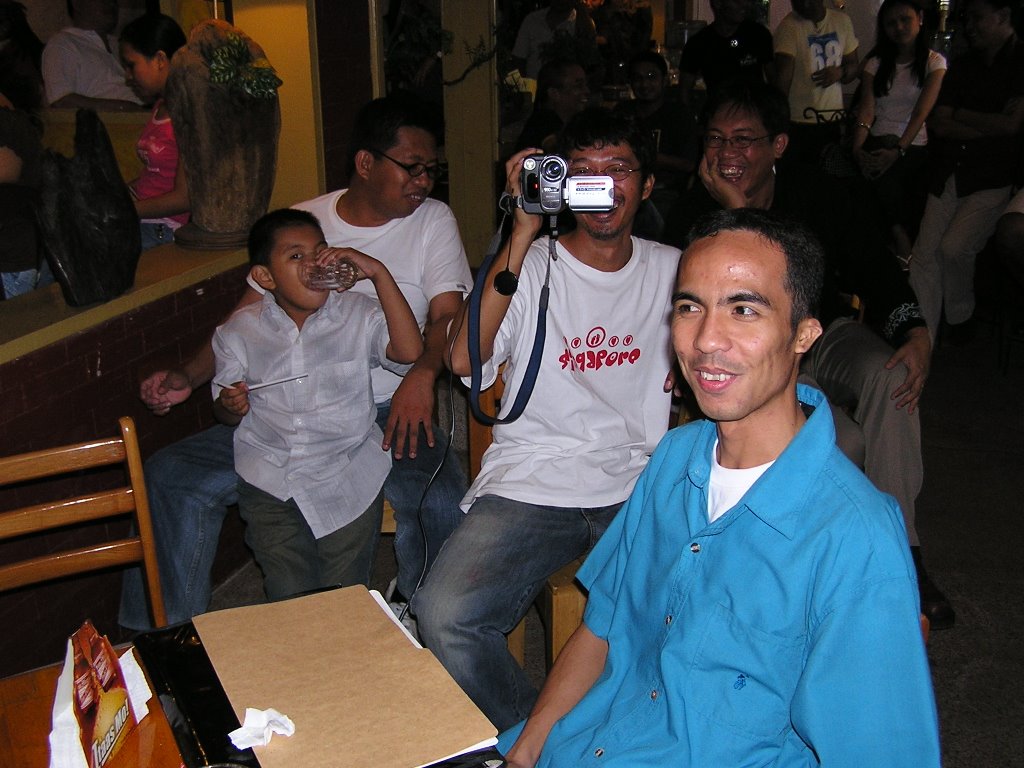
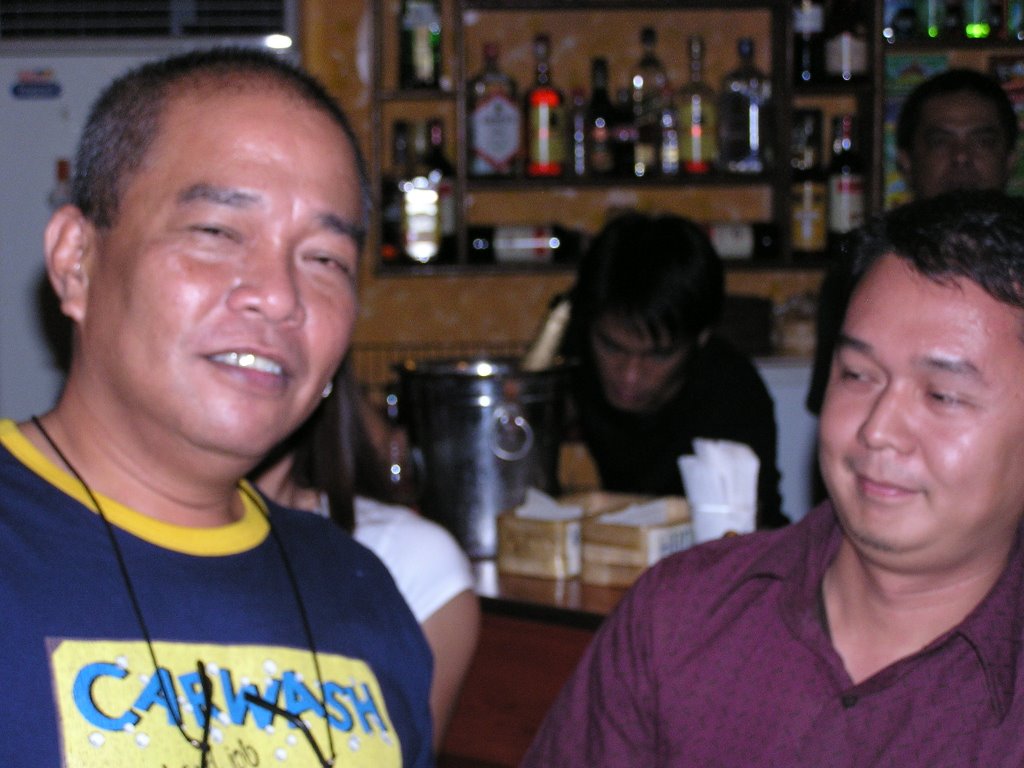
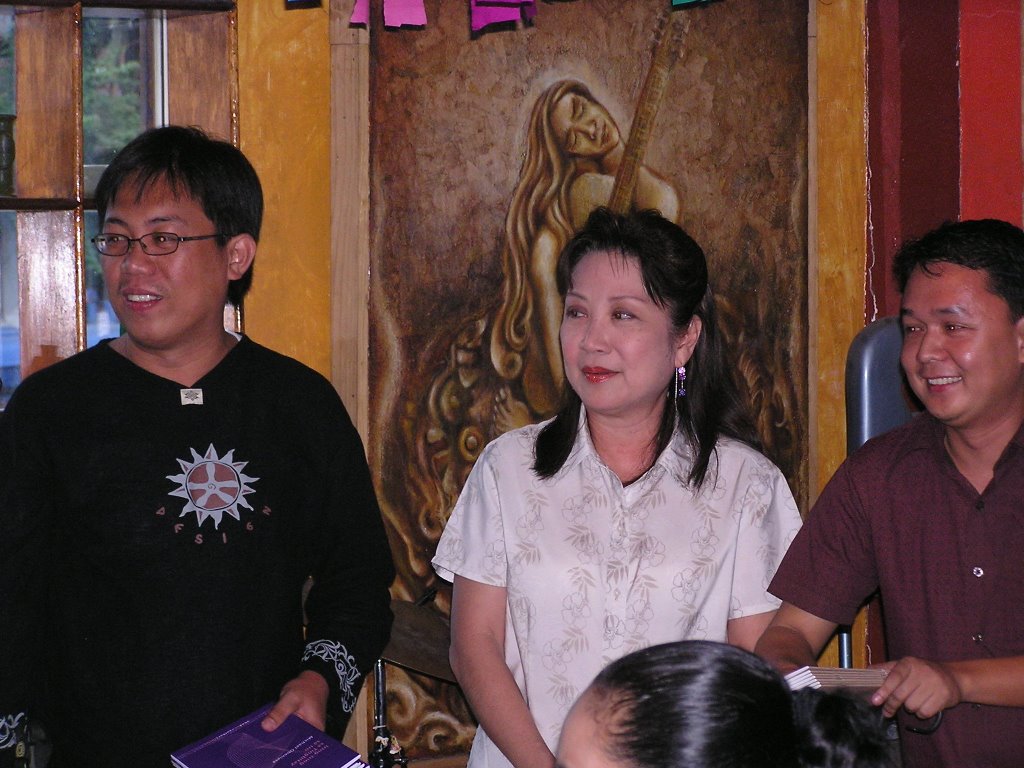
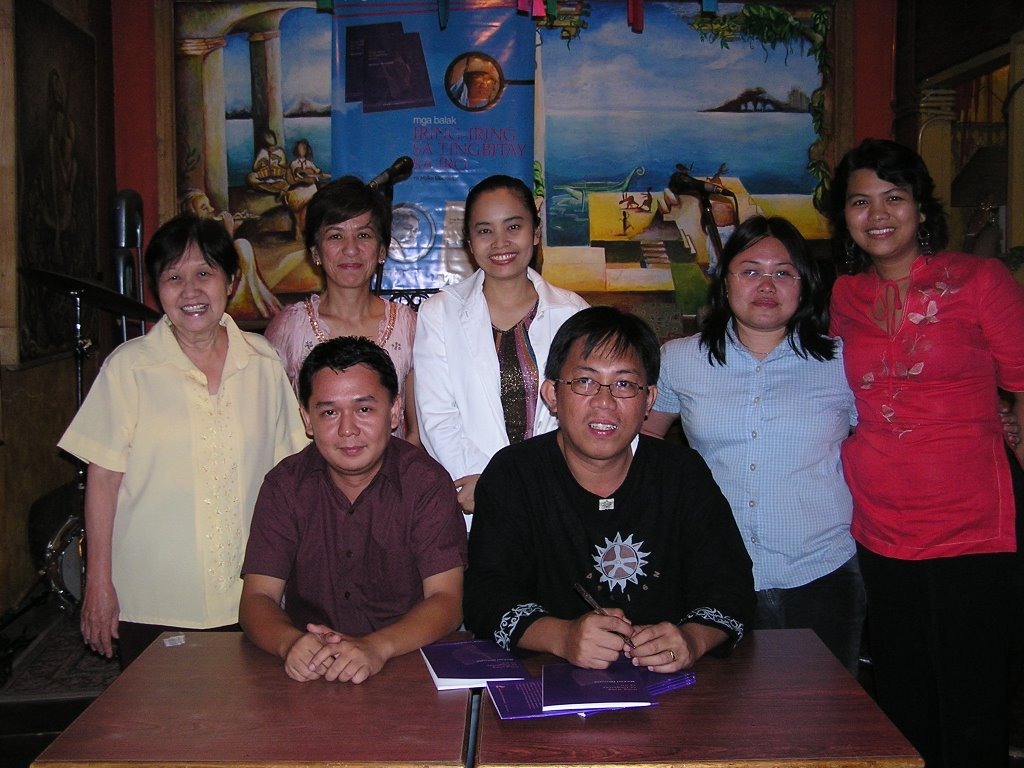
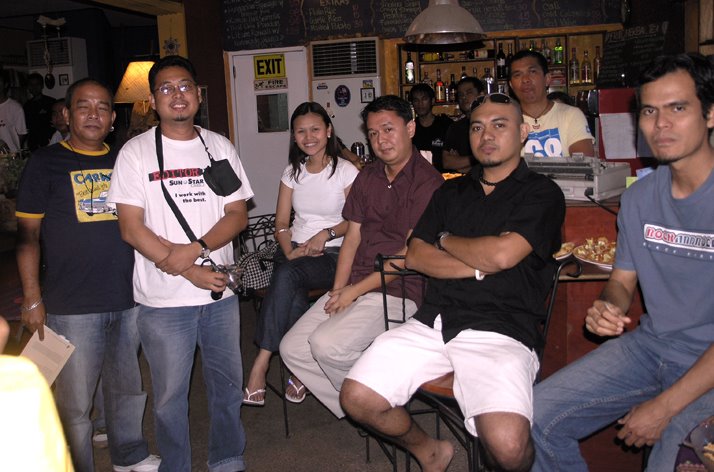
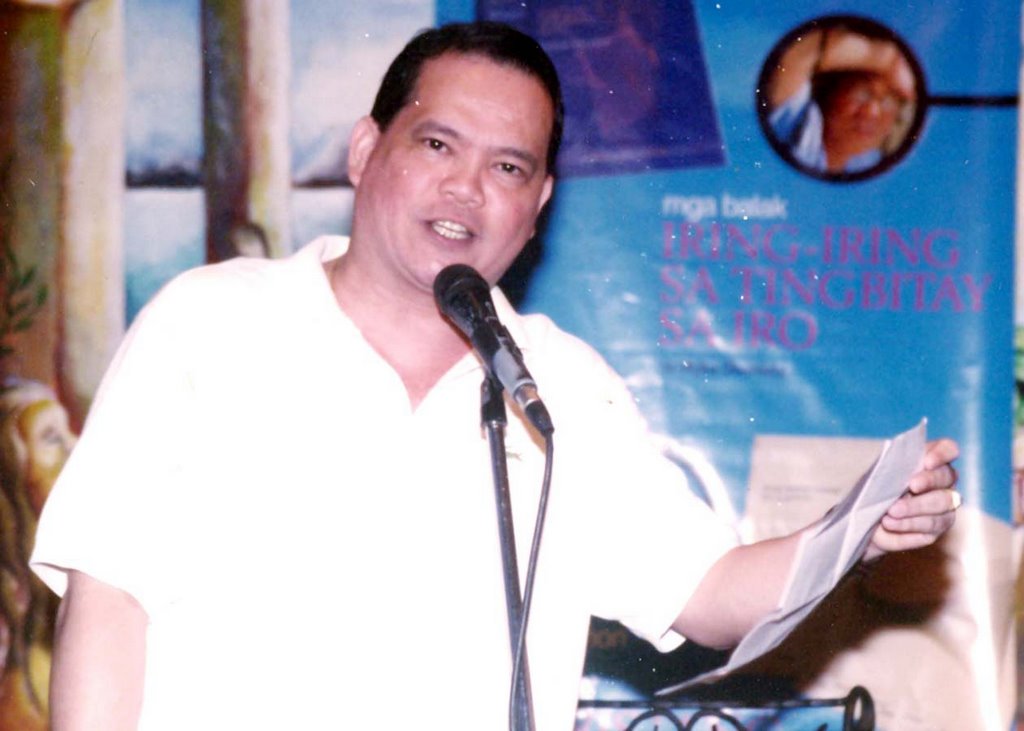
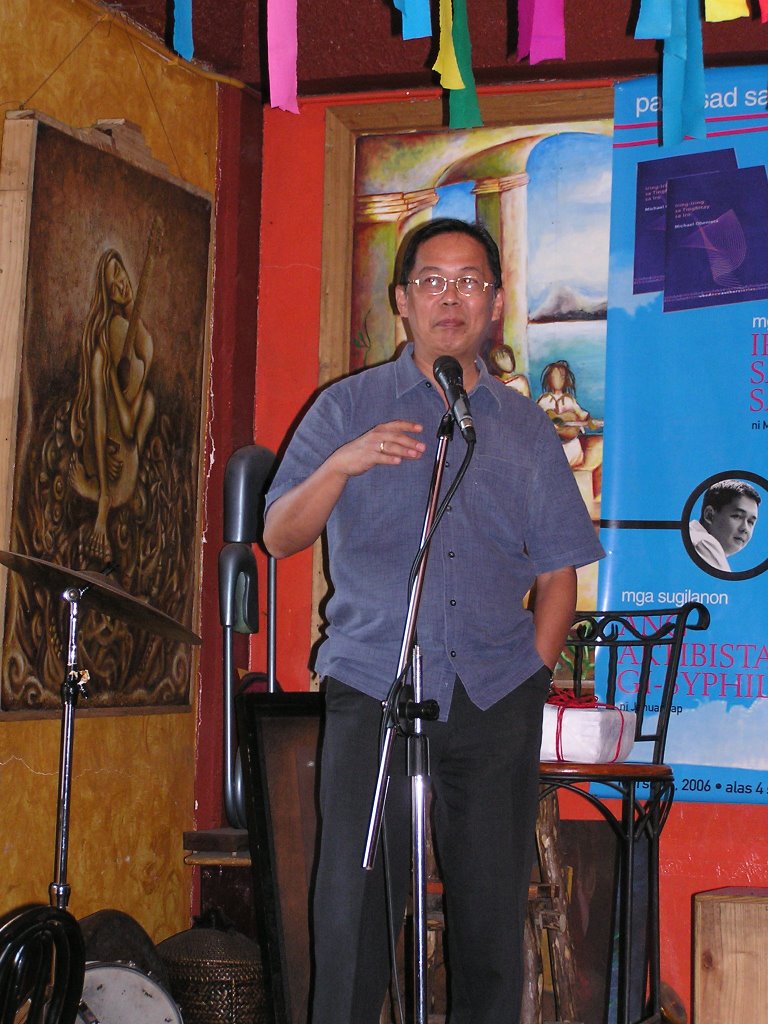
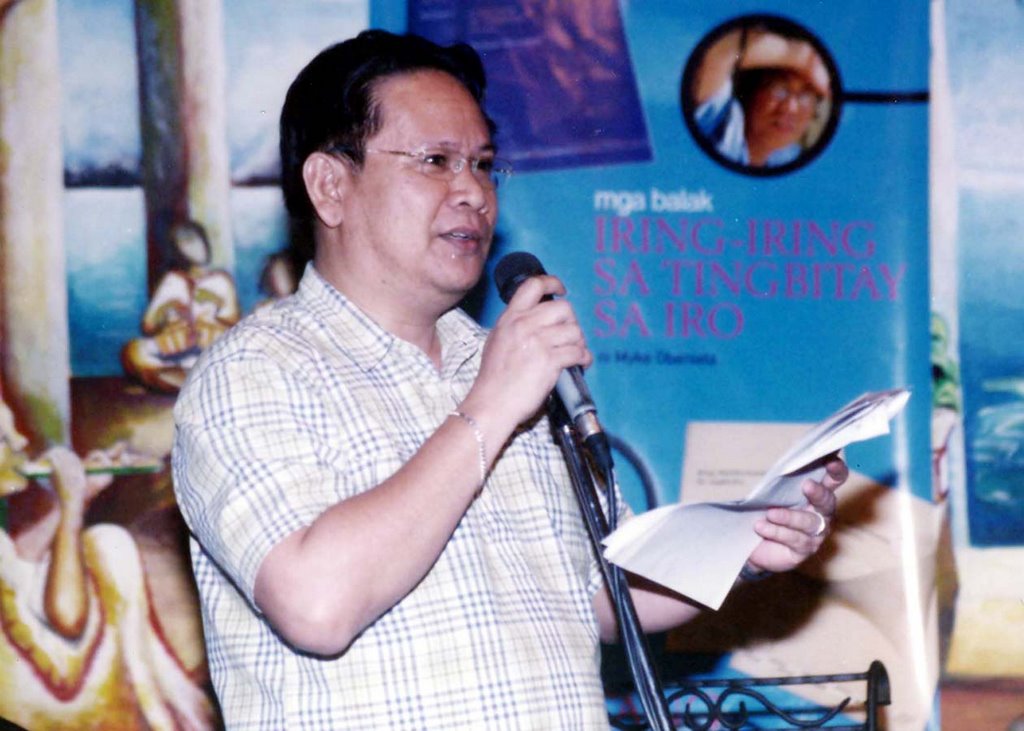
SO THERE WE WERE at Kahayag Cafe, 11th of March 2006, for the joint launching of two Cebuano books: my first collection of poetry (Iring-iring sa Tingbitay sa Iro) and Januar Yap's maiden book of fiction (Ang Aktibistang Gi-Syphilis) published by the National Commission for Culture and the Arts (NCCA) under its UBOD New Authors Series. Now I know book signing can be such a compelling reason to get a masseuse handy.


Monday, March 06, 2006

Three Poems

COMING TO TERMS with the cold, with its dark undertones, has been constant in my poetry. Here are variations on the theme, with a bit of revision since it first saw print on the pages of Philippine Graphic (8 April 1996) and the anthology Likhaan: Best of Philippine Poetry and Fiction 1997 (UP Press).


ALL THE UNSUNG

They come wind-
willed, without a creak
from the rusty gate.

Those who went
are here again, shouting
for their shadows.

My breath clouds over
everything when I
call back. No more

the barking dogs. I
swing the windows wide
and wonder why

the sky lately looks
starved of stars. I
gather myself,

cold. I hear nothing
but birdbone stuck in
the wind's throat.


SPECKS OF SEA

I

I remember, and the breathing
of the drowned draws the ripples.
The waves drowse no more,
wobbling the boat while the wind
blows out the weathered hats
of fishers. I stand wordless at
the breakwater's edge and hear
the burst of spume. Storms recur
in my head. Now returns all
the shipwrecked. All the dead.


II

Flitting by are swarms of fishes.
In the coral within my skull skulks
the coelacanth and I, diving
deeper, peer at it, prying it loose.
As it surges off, unhooked,
my depth-deafened ears hear
the scabrous clarity of scales. I blink,
resurfacing in the eye of the surfs.
Only the remora remains, mossy
in the rustling waters of memory.


ADDRESSED TO A NAMELESS MARINER


This is just to say how I envy the sea
gulls. Theirs is the blue of both sky and water
in one fell swoop while all I can see

are but the odds and ends of leavings: fishbones,
a litter of shells, stranded sargasso... Your bottled
letter found me among these ebbtide

souvenirs. On this usual shore. I stumbled,
tripping over it. Now I know the wind's a guide,
goading the waves on until even my feet

wavered, as when I hurled this missive, this
reply folded like a wing. May air ripple through it
like a sigh. This is just to say goodbye.

Friday, March 03, 2006

Extracts From The First Two Books I've Read in 2006

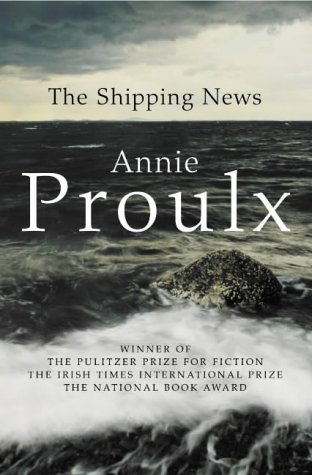
From E. ANNIE PROULX's The Shipping News:

"One of the tragedies of real life is that there is no background music."

:::

"And what we fear we often rage against."

:::

"... he was wondering if love came in other colors than the basic black of none and the read heat of obsession.."

:::

"Was love then like a bag of assorted sweets passed around from which one might choose more than once? Some might sting the tongue, some invoke night perfume. Some had centers as bitter as gall, some blended honey and poison, some were quickly swallowed. And among the common bull's-eyes and peppermints a few rare ones; one or two with deadly needles at the heart, another that brought calm and gentle pleasure. Were his fingers closing on that one?"

:::

"... we are only passing by. We only walk over these stones a few times, our boats float a little while and then they have to sink. The water is a dark flower and a fisherman is a bee in the heart of her."


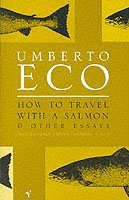
From UMBERTO ECO's How To Travel With a Salmon and Other Essays

"The mass media first convinced us that the imaginary was real, and now they are convincing us that the real is imaginary; and the more reality the TV screen shows us, the more cinematic our everyday world becomes. Until, as certain philosophers have insisted, we will think that we are alone in the world, and that everything else is the film that God or some evil spirit is projecting before our eyes." (How To React To Familiar Faces)

:::

"A writer is someone determined to extend language beyond its boundaries, and he therefore assumes full responsibility for a metaphor, even a daring one." (How To Use Suspension Points)

:::

"It is enough to tell the truth. Naturally, truth comes in all sizes." (How To Write An Introduction To an Art Catalogue)

:::

"Human beings have always been merciless with animals, but when humans become aware of their own cruelty, they began, if if not to love animals (because, with only sporadic hesitation, they continue eating them), at least to speak well of them. As the media, the schools, public institutions in general, have to explain away so many acts performed against humans by humans, it seems finally a good idea, psychologically and ethically, to insist on the goodness of animals. We allow children of the Third World to die, but we urge children of the First to respect not only butterflies and bunny rabbits but also whales, crocodiles, snakes. Mind you, this educational approach is per se correct. What is excessive is the persuasive technique chosen: to render animals worthy of rescue they are humanized, toyified. No one says they are entitled to survive even if, as a rule, they are savage and carnivorous. No they are made respectable by becoming cuddly, comic, good-natured, benevolent, wise, and prudent... Simply put, we must love-- or, if that is downright impossible, at least respect-- these and other animals for what they are. The tales of earlier times overdid the wicked wolf, the tales of today exaggerate the good wolves. We must save the whales not because they are good, but because they are part of nature's inventory and they contribute to the ecological equilibrium. Instead, our children are raised with whales that talk, wolves that join the Third Order of St. Francis, and, above all, and endless array of teddy bears." (How To Speak of Animals)

Tuesday, January 17, 2006

A Cache of Cheap Blessings

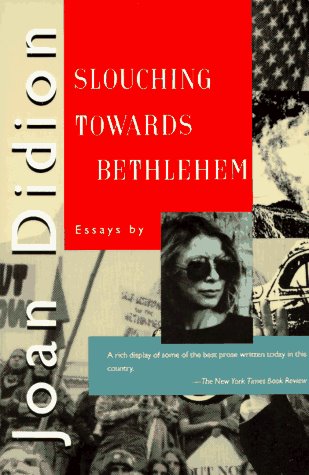
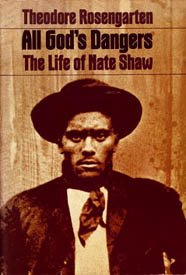
JACKPOTS happen like this: Just when boredom starts to kick in while you're idling through the mall, you spot a book sale. See what I got, scoured from the shelves in one of the stores at Robinson's Cebu. A handful of second-hand gems priced at 10 pesos each---whoa!---here are my first four book acquisitions in 2006:


Slouching Towards Bethlehem. Upon its publication in 1968, this book of essays confirmed Joan Didion as one of the most prominent writers on the literary scene. Her unblinking vision and deadpan tone have influenced subsequent generations of reporters and essayists, changing our expectations of style, voice, and the artistic possibilities of nonfiction. "In her portraits of people," The New York Times Book Review wrote, "Didion is not out to expose but to understand, and she shows us actors and millionaires, doomed brides and naĆÆve acid-trippers, left-wing ideologues and snobs of the Hawaiian aristocracy in a way that makes them neither villainous nor glamorous, but alive and botched and often mournfully beautiful....A rare display of some of the best prose written today in this country."


Herzog. Nobel Prize winner Saul Bellow's "Herzog" received the International Literary Prize in 1965; the story of Moses E. Herzog, a confused intellectual suffering from the breakup of his second marriage, the failure of his life and the specter of growing up Jewish in the middle part of the 20th century.

All God's Dangers. This triumphant National Book Award recipient assembled from the 84-year-old sharecropper's oral reminiscences is the plain-spoken story of an "over-average" man who witnessed wrenching changes in the lives of Southern black people – and whose unassuming courage helped bring those changes about. "There are only a few American autobiographies of surpassing greatness....Now there is another one, Nate Shaw's," raves The New York Times. "When, finally, this big book is put down, one feels exhilarated," agrees Studs Terkel. "This is an anthem to human endurance."

The Soul of a New Machine. Winner of the Pulitzer Prize, and selected by the Modern Library as one of the100 best nonfiction books of the 20th century. Computers have changed since 1981, when Tracy Kidder indelibly recorded the drama, comedy, and excitement of one company's efforts to bring a new microcomputer to market. What has changed little, however, is computer culture: the feverish pace of the high-tech industry, the mystique of programmers, the go-for-broke approach to business that has caused so many computer companies to win big (or go belly up), and the cult of pursuing mind-bending technological innovations. By tracing computer culture to its roots, by exploring the "soul" of the "machine" that has revolutionized the world, Kidder succeeds as no other writer has done in capturing the essential spirit of the computer age.